

Global health insurance costs are set to rise by more than 10% again next year, but the UK will buck the trend by posting a slight easing of inflation.
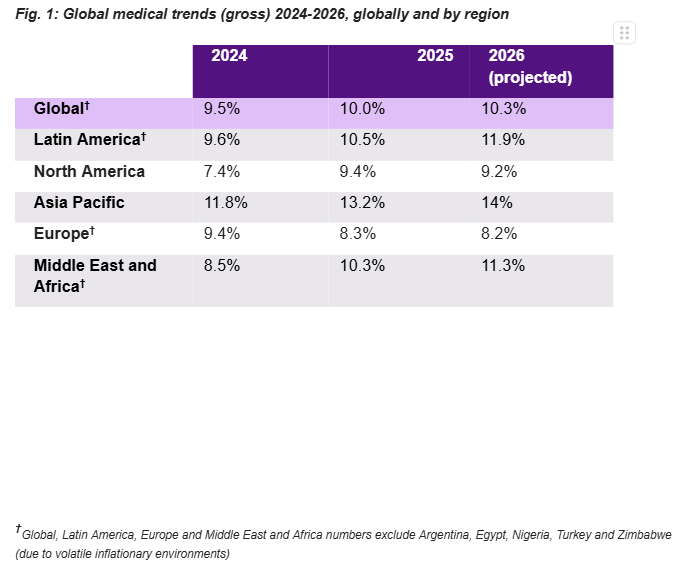
WTW’s survey of health insurers found the average cost of medical health benefits will increase by 10.3% globally next year, continuing the medium term trend.
This follows increases of 10% in 2025 and 9.5% in 2024. Regionally, the highest cost increases are expected in Asia Pacific at 14% while Latin America is predicting the sharpest acceleration in costs, from 10.5% this year to 11.9% in 2026.
The Middle East and Africa also expects to see above average healthcare cost increases at 11.3%, while medical inflation is anticipated to fall slightly in North America, from 9.4% this year to 9.2% in 2026, and in Europe from 8.3% to 8.2%.
However, while the UK’s healthcare inflation of 10.6% this year and 10% in 2026 remains among the highest in Western Europe, 2025 has so far seen this claims trend stabilise, with rates falling for some conditions.

Further cost increases on the horizon
WTW’s 2026 Global Medical Trends report surveyed 346 health insurers representing 82 countries, with input from the firm’s local brokers representing 54 countries.
According to the research, more than half (55%) of insurers surveyed expect further cost increases and for these elevated levels to persist for more than three years, driven by high medical costs, regional pressures on pharmacy and outpatient services and global structural factors.
These include new medical technologies.
This was cited as the top reason for increased costs with three-quarters (74%) of insurers naming it as the primary driver of medical inflation followed by the decline of public health systems (52%) and advancements in pharmaceuticals (49%).
Linda Pham, global health and risk leader for integrated and global solutions, WTW, said: “Despite variations in healthcare provision in different countries and regions around the world, rising medical costs are a consistent trend for all.
“One glimmer of hope for employers is that investment in technologies, including AI, is leading to higher costs at the moment but following this phase new technologies are expected to reduce healthcare cost trends in the longer term.”
Cancer driving cost rises
When it comes to conditions, cancer is driving medical costs globally – named as the fastest growing and most expensive diagnosis for insurers in nearly every region, cited by 57% of insurers globally.
Three-quarters (75%) of insurers also observed an increase in cancer incidence among individuals under the age of 40.
But cardiovascular conditions (50%) are also growing significantly and rank second among the conditions driving medical claims costs, with behavioural health issues (37%) ranked third.
Kevin Newman, head of health and benefits Europe at WTW, said: “The challenge of navigating healthcare inflation for multinational employers requires strategic management.
“This can include investing in education for employees on the use of health benefits, raising awareness of prevention programmes for prevalent diseases like cancer, optimising mental health coverage, and introducing flexibility of benefits.
“Through careful management, employers can make sure they are getting the most out of their healthcare benefits while managing cost inflation.”