
Taking ownership of projects can help insurer leadership cross silos to embrace technology developments and work together, hears Owain Thomas
Download the roundtable supplement for the discussion by following this link.
Deciding when and how to overhaul, update or even remove technology systems is never something to be taken lightly for insurers – the possibilities are seemingly endless while one wrong move could cripple an organisation.
This can result in a hesitation for business leaders to get involved in technology decisions, but this is not being seen within modern insurers.
As the Health & Protection roundtable in association with Comarch heard, when big calls are being made IT leaders are keen for their business’ leaders to embrace the technology process
“It’s about educating the business, because we do want the business to make those decisions, but we want them to be informed decisions,” said Lio Lopez-Welsch, chief information and digital officer of Unum.
“Essentially it’s that education loop and to encourage ownership of the systems they ultimately need or use to do their jobs.
“What good looks like is if we can get them to take ownership of the technology they need to do their jobs and then can educate them to understand the implications of what happens if that technology is out of date or not being properly managed or so on.”
And by doing so, this can make the process easier for everyone when investment is required.
“Hopefully it’s then an easy conversation to have when you say we need to update this and they say ‘absolutely’, they see why it needs to be updated,” Lopez-Welsch continued.
“That’s a much easier conversation when we’re asking for funding if the business stakeholders are there with you saying, yes, this is absolutely necessary, that’s the education piece.
“The thing I feel we’ve made some good progress on, particularly as we’ve got more digital customer-facing and customer-centric, is that’s really encouraged the business owners to take more responsibility for the technology that they need to be successful.
“But it’s a journey, it’s not something that you can say we’re done, it’s just something we’re progressing with.”
Generating better outcomes
This was echoed by other participants and the greater insights available now were highlighted as giving a more solid decision-making process with more certainty of outcome.
“There’s a lot more data to make decisions and because you’ve got the data now, it’s no longer the case that some proposition analyst will say they are going to take a punt on this,” said Calum Thornburn, lead solutions architect of Scottish Widows.
“You now know what to go after because you’ve got enough feedback loops to capture that.
And Thorburn explained the insurer, which is part of Lloyds Banking Group, had evolved its IT operational structure to help enable greater engagement.
“We’ve tried to move to a product and project led approach and the software is part of the product,” he said.
“So it’s not just getting the thing connected at the end and you get the schedule. It’s the entire process of going through that, and the experiences are just as big a part for us now as the actual product that sits on our side.”
There are also purer outcomes-based discussions being conducted which can be empowering for IT teams and business leaders.
As Health Shield IT director Richard Aston highlighted, using technology as an enabler and not overwhelming people with the processes and details can prove transformative.
“I’ve found that the business knows the desired outcomes but they don’t necessarily know how or need to know how to get to the end of those outcomes,” Aston said.
“And so technology forms a part where we’re leading the discussions with the business to inform them of the capabilities, what they can do, and then refer to it.
“Then it becomes a very interesting conversation, because you start to change the mindset of the business about how to get to an end state, and through that conversation, you actually change the business.
“And that’s hugely valuable to any business.”
Empowering leaders
But this is not a one-way street. Leaders within insurers are reciprocating and aligning their organisational structures and teams to take responsibility for products themselves.
This gives them the opportunity understand the processes and consequences of changes and a key chain of command for enabling action.
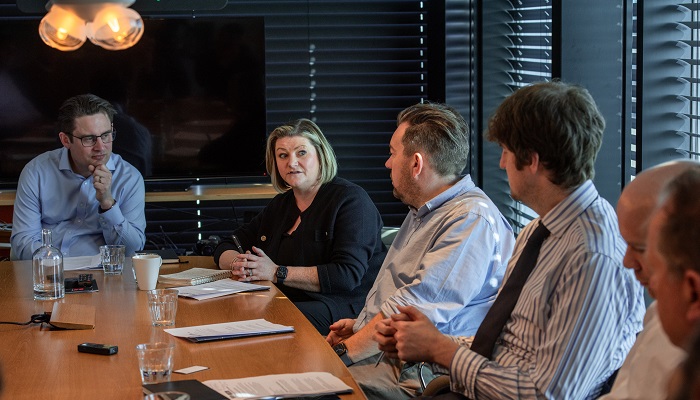
Vitality Life chief information officer Frances Hoyle (pictured centre) explained how the insurer had undergone a significant reorganisation of how its teams operated to just that effect.
“We reorganised the whole of our IT division into product delivery streams that are looking after a segment of the customer journey and nominated an IT director to look after each segment, then the CEO employed a business director to look after the same,” she said.
“So that complexity of dealing with multiple stakeholders who have different opinions and that education piece has gone because there’s now one person specifically employed to be that central owner to manage the objectives and key results no matter what.
“That includes the sales ones, the business drivers, the customer service and the technology objectives which align with that. So we’ve got two people per journey, but it’s a collaboration of product delivery streams, and that has been transformational.”
Hoyle emphasised this had brought together people from across the organisation with the what and the why from product teams and the how and the when from engineering.
Thornburn noted this could have an additional bonus of creating greater engagement and connection through IT teams with business goals.
“It cuts both ways, because the engineering team could suddenly have become invested in what the business is trying to do, and they care about it,” he added.
Aston agreed and recognised the importance of what was being undertaken.
“You’ve taken the agile development model, scaled that up and out as a business model; so you’ve got your product and technology owners and you’re driving it through from that,” he said.
“You must be joining it together at the top as well, to make sure that you’ve got the same common view across systems and product approaches and business approaches?” he asked.
Indeed, Hoyle noted there had been some other process and responsibility changes among senior executives which had been rolled out.
“It’s been phenomenal,” she continued.
“It’s been difficult and we’re not quite there yet, but it’s driven a phenomenal change in how we’re making decisions.”
Meeting international demands
WTW head of technology consulting UK&I Algirdas Dineika was impressed with the approach being taken.
“I haven’t seen a more powerful way to align business and technology,” he said.
“If you go to the product model and then you say ‘you build it, you run it together’, that’s it.”
This was echoed by Capco managing principal Juan Redondo Fajardo who added it was another example of how the technology sector was leading the way.
“We invented the domain driven architecture, and now it’s applied in business,” he joked.
However, there was one set of decision-makers cited who were often not able to be navigated through internal organisational changes.
Freedom Health Insurance chief operating officer Hoosh Myres raised the difficulties which different regulatory commitments could produce.
“Focusing on something more specific to what we do, we also operate in the international health insurance space,” Myers said.
“So for us it’s being able to provide technology solutions that meet not just UK or European, but multiple different regulators’ requirements.
“You’d like to think the use of IT or AI, for example, would be able to be an easy way of doing that, but unfortunately getting these things signed off and approved by some regulators of certain countries is a real challenge.
“So that’s probably our constant daily uphill battle,” he concluded
Download the roundtable supplement for the discussion by following this link.