

Misconceptions about income protection (IP) could be behind the persistently low take-up of the product among British workers, according to Shepherds Friendly.
Research from the mutual found just 14% of UK adults who were working full time had IP.
However, 70% of those polled were aware of the product, meaning lack of awareness is unlikely to be the reason employees are failing to safeguard their earnings, the insurer said.
It found those aged 25-34 are most likely to have cover with 20% taking it up, closely followed by 35-44-year-olds at 18%.
While only 14% of 18-24-year-olds had IP, this fell further to 10% in the 45-54 age group and just 7% of those aged 55-64 – meaning the older generations were least protected in this regard.
Instead, the survey uncovered incorrect assumptions about what might prevent someone being accepted for a policy could be to blame.
Almost half (47%) of respondents said they believed someone’s current or past lifestyle, physical health or mental health would automatically stop them being accepted for IP, with this assumption highest among those aged 35-54 (51%).
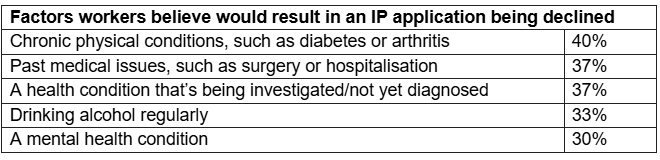

There were also widespread misconceptions about what is covered by IP.
While 69% of respondents think IP paid one’s salary if they are sick or injured, 42% incorrectly believed it paid out in the case of redundancy.
A further 13% believed it pays off a mortgage, 12% thought it paid out a lump sum in case of death and 12% were under the impression it covers medical bills.
The survey also found many workers are unaware of what other financial support was available if they became unable to work due to illness or injury.
More than two-thirds (69%) of full-time workers did not know how much statutory sick pay was; when told the current amount is £118.75 per week for a maximum of 28 weeks, more than a quarter (27%) said this was less than they thought.
Almost half (45%) of employees said their employer offered sick pay beyond the statutory minimum, with a one-third (34%) saying theirs does not, while 21% did not know what they were entitled to.
Phil Nash, chief sales officer at Shepherds Friendly, said: “It’s well-known that income protection is underutilised, but it’s often assumed this is due to a lack of awareness. The results of this survey were therefore striking in revealing the level of misconceptions surrounding the product.
“It is concerning that so many workers are misinformed, not just about IP but also about the other financial safety nets available if they are unable to work, whether from the government or their employer.”
Role of advice
According to the Association of British Insurers, 97% of IP products are sold with advice, highlighting the importance of advisers in dispelling myths around the product.
Nash added: “It’s clear there’s a real opportunity here for advisers and intermediaries. If they can educate their clients on what income protection covers, as well as highlight the potential gaps in the other support available in the event of illness or injury, there’s a significant chance more workers will see its value.
“Increasing the take-up of IP would represent a huge step forward in improving the financial resilience of the UK’s workforce.”
The survey also asked workers what would prompt them to speak to a financial adviser about IP, revealing cost transparency and ease of access were the strongest motivators.
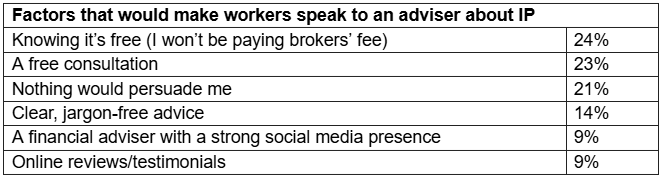

While social media presence and online reviews and testimonials were the lowest swaying factors overall, for workers aged 18-34 these scored much higher, at 18% and 15%, respectively.
Younger people were also more open to engaging with advisers, with only 5% reporting that nothing would persuade them to speak to an adviser about IP – this was much lower than the overall percentage of 21% who said the same.
Young people were more likely to consider a mutual society when exploring IP. While overall, 38% of workers said they’d be more likely to consider a mutual for IP, this rose to 60% for 18-24-year-olds and 56% for 25-34-year-olds.