
Regulators are becoming “quite antsy” on underwriting decisions and the potential for algorithmic biases in insurance is a “very hot topic”, Health & Protection’s IPMI breakfast briefing in association with Flywire has heard.
Furthermore, if underwriting becomes based more on predictive approaches and how people’s lives are expected to progress, attendees were warned this could also be harder to explain to regulators.
Discussing the current state of IPMI underwriting and potential future developments, Joanne Buckle, principal and consulting actuary for healthcare at Milliman, alerted attendees that oversight was becoming increasingly focused on these issues for new technologies.
“We still have lots of issues around privacy, we have issues around explainability, we have issues around bias and underwriting models,” she said.
“Regulators are getting quite antsy in particular about whether we can evidence the underwriting decisions we’re making are based on a proper body of data and are consistent with people that look like our example, or are they very variable depending on individual medical underwriters?”
Buckle continued: “If we look at the future state, we’re going to have much more predictive underwriting. It’s going to be much more tailored around the future treatment patterns that we expect someone to adapt, rather than the historical treatment patterns that exist in our historical data.
“That will make it much more difficult to explain to regulators what they are, but it’s fairly inevitable depending on the regulatory environment that you’re in.”
‘Very, very hot topic’
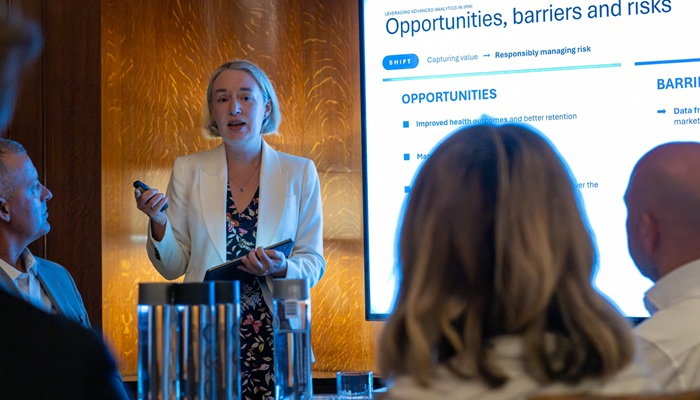
Buckle (pictured) continued expanding on the influence and sources of different data streams for insurers to use and highlighted further regulatory issues.
She noted that decisions around pricing and algorithmic biases were also very hot topics for insurers to be aware of.
“We’ve got a lot of regulatory constraints, particularly around the pricing side,” Buckle explained.
“With individual risk scores we need to be really clear – are we using that for pricing? Are we not using that for pricing? How are we allowed to use that?
“Are we using it to pull people out to identify them for case management intervention? Are we using it to find people for disease management type programmes.
“Those all have potential for different algorithmic biases. Regulators are very, very hot on this at the moment, particularly in the EU; that whole area around fairness and how you use algorithms in your business is a very, very hot topic,” she concluded.