

Private medical insurance (PMI) funded hospital admissions fell in the second quarter of the year, down 2,000 on the corresponding quarter of 2024.
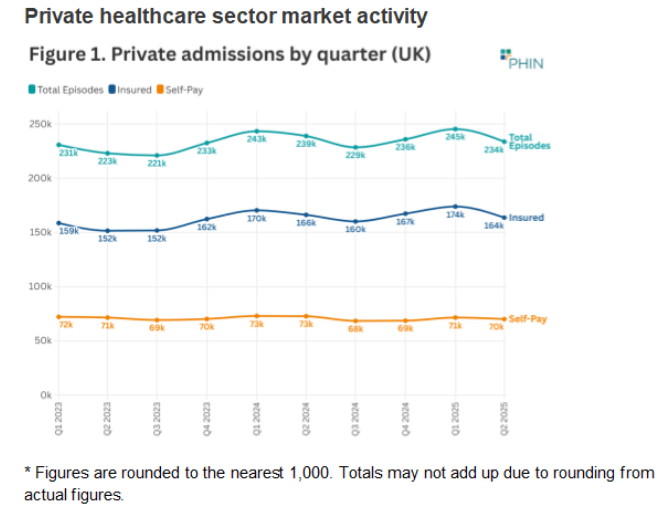
Private Healthcare Information Network (PHIN) data showed 164,000 hospital admissions through private medical insurance (PMI) in April to June 2025, down from 171,000 in January to March following the typical seasonal pattern.
Total reported private hospital and clinic admission figures in the UK remained high at 234,000 in Q2 (April to June) 2025.
However there were around 5,000 fewer admissions (-2%) than in the same period a year earlier, according to the latest PHIN figures.

PHIN collects this data from the more than 650 hospitals across the UK providing private diagnosis and treatment. They are legally required to submit data to PHIN so that it can make this information available to the public.
The decline was witnessed across each of the UK nations except for Scotland which saw an increase in reported admissions.
- England: 206,465 admissions (-3%)
- Northern Ireland: 5,765 admissions (-3%)
- Scotland: 13,455 admissions (+3%)
- Wales: 8,015 admissions (-2%)
Top private procedures
Cataract surgery (19,150) continued as the top procedure by number of admissions, with chemotherapy (18,540) in second, and diagnostic upper gastrointestinal (GI) endoscopy (11,325) in third.
Chemotherapy was the only procedure in the Top 10 by volume of admissions which increased from Q2 2024 to Q2 2025.
When looking at just admissions funded with private medical insurance, chemotherapy (17,240) was the top procedure by some distance with almost double the number of admissions of diagnostic upper GI endoscopy (9,890) in second place.
The most popular procedures among self-payers for their treatment were cataract surgery (11,795), hip replacements (3,910) and knee replacements (1,930).
Over the same period, private hospitals and clinics also conducted more than 1.3 million NHS funded procedures. The majority of these were in ophthalmology, and trauma and orthopaedics.
PHIN director of technology and insights Richard Wells said: “The apparent slow down in private healthcare admissions could represent several things. For instance, it could reflect improvements in NHS waiting lists, or a change in the type of procedures people are looking for and the way they are delivered.
“For example, the popularity of weight loss drugs such as Ozempic and Mounjaro could be contributing to the 58% decrease in reported gastrectomies for weight loss.
“New clinical and technological developments also mean more care can be delivered without a patient needing to be admitted to a hospital or clinic so they would not be included in our figures.
“The slight increase in private admissions for chemotherapy (2%) – and the fact that it is the second highest procedure by volume – which is driven by demand in England, could be linked to recent reports that almost every hospital trust in England is failing to meet the key NHS waiting time target for cancer care so some patients are seeking care elsewhere.”