
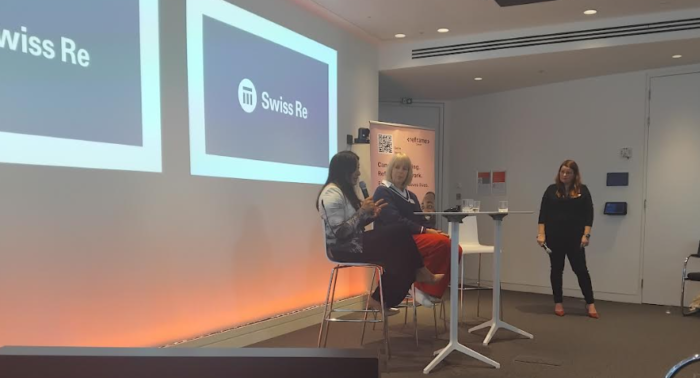
Private health screenings through an employer can dramatically improve health outcomes for workers by detecting cancers early, saving lives and benefiting providers and the NHS alike.
This is according to Dr Seema Dadhania, a clinical oncologist at Reframe Cancer (pictured left), who was speaking at an event organised by the cancer support specialist at Swiss Re’s offices in the City of London yesterday.
Health economic model built on population
While Dadhania described cancer screening as an “extremely powerful” tool, she maintained that cancer screening is a health economic model built on a population level.
“It is what is best for the population,” Dadhania said. “It is not what is best for you as an individual.
“In the USA, breast cancer screening by mammography is open for women from the age of 40 because in the USA, their health economic programme allows funding for women between the ages of 40 and 50 as well as above.
“And in prostate cancer in this country, we do not openly offer PSA screening. It is on an asked basis, so it is not openly discussed quite so often as breast cancer or bowel cancer is.”
Extending cancer screening
Dadhania added that while screening can pick up cancer early, there are age groups where it is not offered.
“There may be places which can offer screening at a younger age – particularly because we’re seeing cases like bowel cancers happening in much younger people – in 20-year-olds and 30-year-olds,” she continued.
“There may be opportunities to extend cancer screening and make it open to people who would not otherwise get this same opportunity.”
Saving lives
And where screening is offered, it really does save lives, Dadhania told delegates.
“Breast screening will save 1,300 a year, cervical screening 4,500 lives per year and bowel screening will see a 25% reduction in bowel cancer deaths and that’s simply because we’re picking up cancer earlier,” she continued.
“Overall around 90,000 cancers were detected through screening in the last five years and that’s a really powerful statistic. That’s people not going through extra treatment, invasive treatment or being taken away from their loved ones because cancer is being diagnosed sooner.”
Curing patients
When asked by Health & Protection about the difference a private screening from an employer can make to health outcomes, Dadhania revealed the rate of cure in stage one cancers globally can be as high as 70%, 80% or even 90% for certain cancers.
“So that means oncologists and surgeons can cure your cancer and it will not come back again,” she continued.
“If you’re diagnosing cancer later, stage three and stage four, that will have a direct impact on your survival.
“So, for example, a breast cancer diagnosis in stage four may have a survival of two to three years. A breast cancer diagnosed at stage one will have a normal life and hopefully it will not be the breast cancer that is the cause of death.”
Years of life saved
For individuals screening can equate to years of life saved,” Dadhania added.
“On a global population level, there is a cost to the health system, more treatment, more complex treatment come with stage three and four cancer.
“So the NHS and the private sector don’t want people to be diagnosed at that stage because the cost of delivering treatment is better or cheaper at stage one and stage two and that is why screening is a good population level way of picking up stage one cancers.”
Phenomenal difference
Picking up the point in a subsequent session, Nikki Cannon (pictured centre), who was brought on board on by Reframe last May to help deliver its own screening programme, maintained that while NHS bowel cancer screening runs from the age of 50, there is no intention to lower that, even with incidents of bowel cancer rising again.
“The difference that stage detection makes is just phenomenal,” Cannon continued.
“We know early diagnosis is a good thing, but I don’t think everyone always really appreciates quite how vast the difference is.
“So a late stage bowel cancer diagnosis is 10% survival rate, tiny. Early stage, it’s over 90%. The difference is just vast.”
Angry surgeons
Cannon added that the fact that bowel cancer screening is not offered to patients at an earlier stage makes them “really angry”.
“We should not be seeing people die from bowel cancer because it’s a simple test,” she continued. “It’s cheap. It’s easy to do. It has no risk and we shouldn’t be seeing it.
“So early diagnosis is the absolute game changer.”