
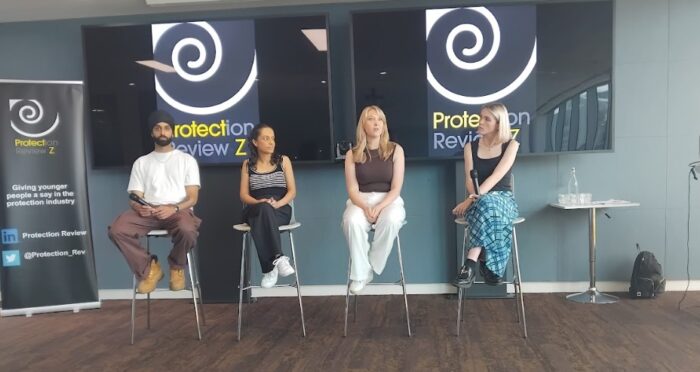
Generation Z (born between 1997 and 2012) needs to be underwritten in a different way – mindful of their propensity to eschew smartphone use and openness around mental health.
This was one of the key conclusions from a panel session at Protection Review’s Protect Z event at UnderwriteMe’s offices in London earlier today.
Eschewing smartwatches
Picking up on a point raised over the morning that Generation Z does not like smartwatches, Laura Mitchell, marketing manager at Guardian, (pictured third from left) agreed that “very few” of her peers use them.
“Generally I think that comes from a place of being a very sceptical generation,” Mitchell continued.
“We give away so much of our information online.
“We’ve got profiles online – Instagram, TikTok, Facebook, a lot of people my age have had those platforms since they were really, really young and I think have grown up and realise the amount of information they have exposed to the entire world is vast.”
Sharing information
Mitchell added that this generation is more aware that the information they share goes to large companies like insurers.
“If you are linked up to a smartwatch and you’re feeding that information into an insurer, that’s your personal health data,” Mitchell continued.
“And I think a lot of people in our generation are acutely aware that maybe more than they are willing to give away.
“It is an interesting point and how we encourage them and how they use smartwatches.”
Mitchell maintained that rather than encourage this generation to use smartwatches in order to secure lower private medical insurance (PMI) premiums, that perhaps they need to be underwritten in a different way.
“Do we want to encourage them to start using that?” Mitchell continued.
“Is there another way? This generation is much more aware of their health. They’re using gyms more, smoking less, drinking less and I think they are much more open about their mental health as well.
“And it’s whether or not we reward that in different ways. Perhaps we should be underwriting differently.”
Asking different questions
Mitchell suggested that perhaps providers should be asking different questions.
“I’m not sure smartwatches are necessarily the only way we can reward young people for being a healthier generation in insurance and getting people to engage in that way,” she concluded.
Mental health exclusions
But Jivtar Singh Chawla, trainee mortgage adviser at Foxtons (pictured far left), also pointed out that there is an additional reason as to why providers may want to think differently about how this sector of society is underwritten.
“When we apply for certain insurances like income protection, we take into account exposures especially with mental health, we get exclusions or you can have declines for serious mental health,” Chawla explained.
“But when it comes to getting the insurance itself, some insurers have options like talking to a mental health nurse as part of their value added services, but that doesn’t really work well if you can’t get insurance.”
Challenging providers
Chawla maintained that if providers are offering such platforms then surely they can be challenged in order to ensure Generation Z can gain access to insurance.
“One of the main things is mental health,” he continued. “That’s what I try to challenge the industry to look at it differently.
“This should be able to underwrite it well enough so that people can be insured especially with income protection that if they do want to take some time off work, it shouldn’t stop you from getting it or provide some sort of exclusions,” he concluded.