
To secure customer loyalty and long-term growth in an evolving market, health insurance firms must now offer more than just policies, according to Matthew Goldsmith, managing director at Trawick International GmbH.
Diversifying into comprehensive service propositions is proving crucial, he stressed, while also identifying key potential growth markets for international private medical insurance (IPMI).
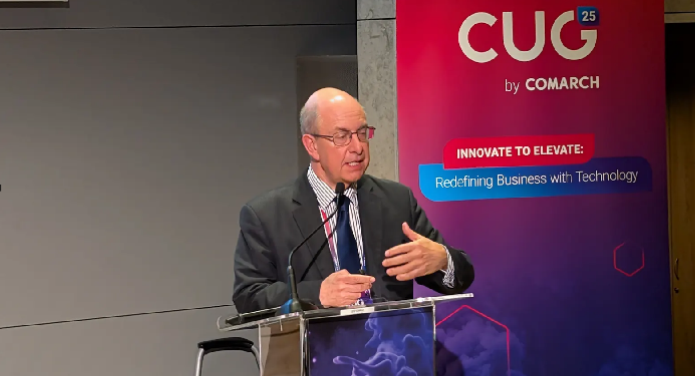
“I’m interested in selling insurance products to corporate groups, to individuals – but I’m also interested in selling on services, because it helps make them sticky to us,” Goldsmith (pictured) said at the Comarch User Group 2025 conference in Krakow, Poland.
“The customer isn’t only buying insurance products but is buying service products and service propositions – then this can be much harder for them to walk out the door.”
Growth opportunities
Overall, Goldsmith was clear that growth opportunities abound with there being many reasons for more people to be considering and in need of health insurance.
“Private healthcare costs are continuing to rise. It’s very clear that with an ageing population the demand for certain types of insurance products and the service support we’re offering is only going to grow,” he said.
“Every single forecast points to health insurance having still competent growth.”
The US market remains dominant, accounting for “about 62% globally”, but there are opportunities for growth elsewhere as well.
Despite the US market’s importance, Trawick International is expanding into Asia, Africa, and niche markets to follow these possibilities, Goldsmith explained.
He believes “the one size fits all isn’t really the case in health insurance anymore.”
He noted: “Other markets are catching up – Asia Pacific has double-digit growth projected going forward and even Europe with a mixture of state systems and top-up insurance plans, we still think there is going to be constant growth for us going forward.”
Growth is also driven by expatriates, multinational companies, and a growing number of high-net-worth individuals, Goldsmith said.
Another factor is digitalisation.
“Digitalisation is transforming the industry – we’ve heard that in terms of the power of AI and indeed non-AI capability,” Goldsmith stated.
Telemedicine, covering “not just GP video services, but also diagnostic services,” is a key area within service propositions.
Goldsmith sees a clear niche: “Employers are moving from not just insuring their people, but keeping them healthy. It has a cumulative positive spiral that by keeping them healthy it also keeps our claims costs down and and keeps our premiums down going forward.”
Weaknesses and threats
However he also identified some key weaknesses and threats, and that included the double-edged sword of an aging population.
Goldsmith said: “An aging population is a drive on productivity – by 2030, one in six individuals on the planet will be age 60 or over.”
But another area of concern is regulation.
“One of the most difficult areas I think for intermediaries going forward is handling the whole legal and regulatory complexity,” he continued.
He pointed to a considerable rise in financial conduct reporting requirements with expansion: “It’s a difficult thing to manage. You start moving into new markets and you find that you have to basically learn about the regulatory systems that go on there.”
Technology and future strategy
Regarding technology, Goldsmith noted that artificial intelligence (AI) and automation have gone into “the processing side of things”.
“The focus of AI at the moment has been on – let’s make your costs low and try and improve your value chain,” he said.
“It will make sense if you can use that technology to give you a competitive advantage to identify your customers and to be very customer-centric – it makes a lot of sense.”
Looking ahead, Trawick is “also trying to move into life and disability”.
Overall, Trawick’s future strategy includes expanding into new international markets, strengthening its digital channels, working with partners, and leveraging AI.