

More than 230,000 UK companies have multinational operations with SMEs and the technology sector driving the international expansion as outbound and inbound moves are increasing.
Research conducted for Howden Employee Benefits by Beauhurst found 234,000 businesses in the UK had multinational operations spanning 128 countries, with Europe the most popular destination.
It noted the vast majority of these (84%) were SMEs which meant global expansion was no longer the exclusive playground of FTSE 100 giants.
Meanwhile, the UK itself has become a hyper-competitive magnet for international commerce, recording 115,000 inbound companies navigating the local market as of May 2026.
The researchers said Beauhurst’s inbound identification was based on corporate structure data which was a verifiable signal of whether a non-UK company was active in the UK, either through a branch office, a registered overseas entity, or a UK legal entity incorporated by an overseas parent.
For outbound businesses, Beauhurst extrapolated outbound signals from its proprietary data, which it said drew on multiple indicators including analysis of Companies House reporting and website insights. It noted companies operating overseas in name only such as holding companies had been removed.
The firms said the international surge was heavily propelled by the UK’s youngest technology enterprises with 24,700 of those companies fewer than five years old.
Within this next-generation cohort, more than 3,000 operate in the digital and technology sector, including 565 specialised AI companies expanding overseas, they added. (see table below)
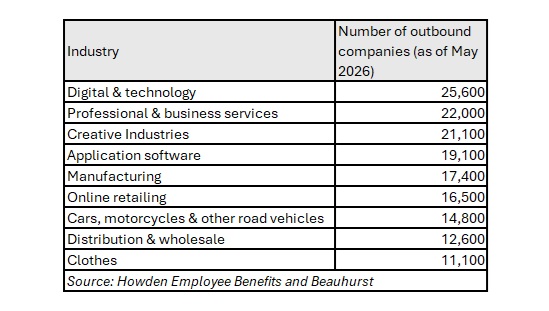

Europe leading destination
Europe remained the dominant destination for this expansion by a considerable margin though other regions such as Asia are growing in prominence.
There were 84,800 outbound operations across Europe – nearly five times the volume of the next largest region.
More than 17,000 UK businesses had operations in Asia, while almost 9,000 were in the Pacific region.
Howden Employee Benefits managing director for global employee benefits services Mark Ramsook (pictured) said: “To win the international talent war, emerging multinationals need enterprise-grade benefit structures built for lean teams.
“For UK firms operating overseas, benefit design, financing models and benchmarking are essential components. They let agile tech and AI businesses offer consistent, compliant and competitive packages to small, distributed teams, without the administrative burden a traditional enterprise carries.
“For inbound firms, the challenge is translation: converting expectations like US-style 401(k) and healthcare into local UK equivalents such as private medical insurance, auto-enrolment pensions and life assurance, so they can attract and retain local talent from day one.
“As the line between local start-ups and global enterprises blurs, a compliant, localised and competitive benefits proposition is no longer optional. It is increasingly what separates businesses that scale internationally from those that stall.”