

Improving staff health and wellbeing is one of the two most important reasons for businesses to offer benefits in kind to their staff, according to research from HM Revenue and Customs (HMRC) released today.
In a quantitative survey, the most common reasons employers gave for offering benefits in kind to their employees were that it helps retain staff at 38% and that it improves staff health and wellbeing – also 38%.
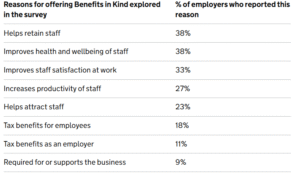

And in qualitative interviews, employee retention, the health and wellbeing of staff, staff satisfaction, and employee recruitment were the most common reasons employers gave for offering benefits in kind in the qualitative interviews.
The hope was that, by improving health and wellbeing and staff satisfaction, this would result in better attendance and less staff sickness.
Medium and large employers (49%) were significantly more likely to report staff retention as a reason for offering benefits in kind, compared to 37% among small businesses.
The research was carried out for HMRC by IFF Research to look at the range in benefits in kind offered and expenses reimbursed by employers.
Remuneration for employees takes many forms as in addition to paid wages or salary, employers frequently offer non-cash remuneration to employees, including taxable and non-taxable benefits in kind and expenses.
The overall objective of the HMRC research was to better understand the current and future use of benefits in kind and expenses, including understanding the incidence of employers offering a range of benefits in kind and expenses.
IFF Research conducted a quantitative telephone survey consisting of 1,496 interviews with employers of varied business size and industry sector between 7 November 2022 and 20 January 2023.
After the quantitative survey, 30 follow-up in-depth interviews were conducted with a range of employers that took part in the survey between 13 January and 15 March 2023.
Covid effect
The HMRC report said external events, such as the Covid-19 pandemic, have also increased internal and external pressure on employers to review the adequacy of their healthcare and risk benefits, such as occupational sick pay, as well as their overall financial and mental support for their staff, such as for those who have had to shield at home.
Salary sacrifice
Most employers said they did not offer benefits in kind through salary sacrifice (90%), with less than one in 10 offering it (8%).
Salary sacrifice was more prevalent among medium and large employers, with roughly a quarter offering benefits in kind through salary sacrifice (26%). Small employers were less likely to offer it at 5%.
Employers offering benefits in kind through salary sacrifice were asked what proportion of their employees in receipt of these benefits were basic rate, higher rate, and additional rate taxpayers.
On average, these employers said that around half were basic rate taxpayers (51%), around one fifth were higher rate taxpayers (21%), and 4% were additional rate taxpayers.
Half of employers offering benefits in kind through salary sacrifice did so to all staff, including hourly paid staff (50%).
Just over two-fifths of employers (43%) offered it to all salaried staff.
A minority of employers said they only offered benefits in kind through salary sacrifice to directors, or middle managers and above.
Employers offering benefits in kind through salary sacrifice reported that salary sacrifice was effective in incentivising employees to take up benefits in kind.
Around two-thirds (67%) said it was very effective (31%) or fairly effective (36%), with only 3% of employers feeling it wasn’t effective at all.
In the qualitative interviews, employers noted that the key advantage of offering benefits in kind through salary sacrifice was reducing the cost of offering the benefit for the employer, as they can save on National Insurance contributions.
Employers also noted that the salary sacrifice arrangement also enables employees to reduce the amount of tax they pay, saving them money (compared to accessing the benefit in the open market).