

The UK is lagging behind its international peers in managing chronic health conditions, according to a report from Zurich.
It’s research found the UK was operating in a “chronic reality”, where millions were living longer but spending years managing conditions such as diabetes, heart disease and dementia.
Across developed economies one in three adults were living with a long-standing illness or health problem.
UK in middle of the pack
The Value of Chronic Care report is based on analysis across all 38 Organisation for Economic Co-operation and Development (OECD) countries from 2014 to 2023 covering more than 200 chronic conditions.
Despite ranking third in the world for readiness, the UK was in the middle of the insurer’s Chronic Care Index (22nd) placing it ahead of countries like Germany (24th) and the US (27th), but behind France (15th), Ireland (13th) and Australia (8th).
The index combines the scores for chronic disease burden and health system performance across all 38 countries of the OECD countries with the lowest burden and strongest systems place highest.
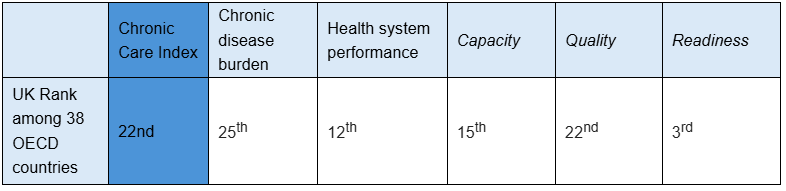

While the UK has a moderate disease burden (ranking 25th), its health system performance was relatively strong (12th) due to its high level of readiness (3rd).
However, this contrasted with weaker quality (22nd) and capacity (15th) leading to limited outcomes.
In practice, this means patients were not always seen early enough and conditions were more likely to deteriorate while people were waiting to be seen, leading to increasing pressure on hospitals and emergency care.
System under chronic pressure
The report points to a fundamental misalignment at the heart of the UK’s healthcare system; fewer people were dying early but many more were living longer with illness, and more were requiring continuous care rather than one-off treatment.
This has led to chronic disease being the dominant driver of demand, placing strain on hospitals, A&E and other acute services.
But the pressure on the UK was being compounded by demographic change, with older populations far more likely to live with multiple conditions at once.
This leads to more complex cases, longer treatment and repeated admissions to hospital. As the UK’s population ages, the system has to sustain its performance and this intensifies year-on-year.
European countries on a different path
In contrast, countries such as the Netherlands were showing how systems could adapt to the same pressures more effectively.
The Netherlands ranks second on the Chronic Care Index, despite only mid-level spending and a moderate disease burden (20th).
Its health systems focus on strong primary care and coordination, early intervention and preventive support, and lower rates of avoidable hospital admissions, led to it ranking first globally for health system performance.
It had the highest quality score in the OECD (1st) and a high readiness score (1st), meaning patients benefit from more consistent and integrated care and the country was able to manage chronic conditions before they escalated into emergencies – despite a weaker capacity score (13th).
Likewise, Switzerland which ranked first in the Chronic Care Index demonstrated that even with an ageing population, strong coordination, trust and continuity of care can prevent worse outcomes over time.
Chronic disease develops silently
Peter Hamilton, head of market engagement at Zurich UK, (pictured) said: “The UK is exceptionally good at treating people once they are sick, but chronic disease doesn’t start in hospital – it develops over years and often silently.
“Countries that perform best focus relentlessly on early detection, prevention and ongoing management. The Netherlands shows that this isn’t about spending but more but about organising care differently.
“The NHS is one of the strongest acute care systems in the world, but that’s not the challenge it’s facing any more. What we’re seeing now is a system designed for emergencies being asked to manage conditions that last decades.“
Hamilton noted that when care was not joined up, patients deteriorate – and that inevitably pushed demand into hospitals.
“The UK needs to manage conditions before they escalate in order to ease pressure on hospitals otherwise acute systems will remain under constant strain,“ he continued.
“Improving chronic care requires not only expansion, but redesign.
“This means connecting services, improving coordination, and supporting individuals over time. Warning signs are often first visible in the workplace – through absence, reduced performance, or shifts in behaviour.
“This makes workplace systems, employer engagement, and employee benefits a key part of the chronic care response, particularly for conditions that develop and persist over long periods.
“Supporting people to remain at work, or to return in a structured way, is not only an economic priority, but can be a health outcome in itself – all of which are key themes of the Keep Britain Working report.”