

Younger and midlife age groups are experiencing the greatest mental wellbeing challenges, according to research from Aviva.
Aviva’s latest Story of Health research among 2,000 adults reveals that mental wellbeing challenges are most pronounced for young adults aged 18–24 and those in midlife aged 45–54.
It found that while young people are proactively prioritising their mental health through healthy habits and social connection, both groups reported lower levels of mental wellbeing than the average across all age groups, highlighting the need for more tailored support across life stages.
Poor mental health
Among 18-24-year-olds, fewer than half (47%) rated their mental health as good, compared to 62% across all age groups, while nearly a quarter (22%) described their mental health as poor.
Those aged 45-54 years were also reporting lower levels than other age groups.
Around half (48%) of 18-24s surveyed felt overwhelmed or stressed frequently and 43% often felt anxious or worried. A third (33%) reported persistent low mood or depression.
Around a quarter (26%) of those aged 45-54 years reported persistent low mood or depression and slightly more (28%) said they often or always felt anxious or worried.
However, for the broader population, only a quarter (24%) said they often felt anxious or worried, and one in five (20%) reported frequent low mood.


Differing happiness levels
Happiness levels also indicated a difference across age ranges: half (50%) of 18–24s and slightly fewer (46%) of those aged 45-54 rated their happiness as good compared to around three in five (59%) people across all age groups.
Young adults were found to be navigating a complex mix of life transitions – early career steps, financial independence, and finding their identity.
Meanwhile many of those aged 45-54 were likely to be supporting older children as well as their parents.
Access to support also varied. Just over half (51%) of all adults said they had the mental health support they needed, compared to 44% of 45-54 year-olds and 42% of young adults aged 18-24.
Almost two in five (39%) 18–24s and more than a third (35%) of those aged 45-54 said they lacked adequate support, higher than the average across all age groups (31%).
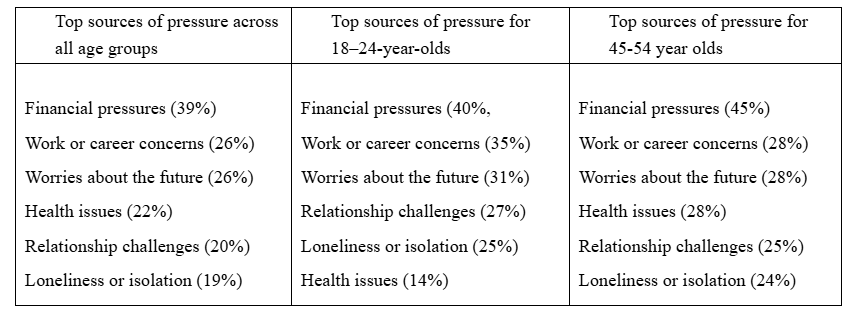

Seeking support
Across all age groups, the most likely places people would seek mental health support if they had a concern were GPs or other health professionals (40%), friends and family (36%), a therapist or counsellor (20%) and mental health charities or helplines (14%).
Young adults were more likely to turn to friends and family (44%) for support, rather than their GP or another medical professional (21%).
This trend was different among those aged 45-54 – 44% would seek support from their GP or another medical professional.
Aviva’s research showed that more than a third (36%) of 18–24-year-olds often or always felt lonely, compared to a quarter (25%) across all age groups.
A similar number (27%) of those aged 45-54 said that they often or always felt lonely.
Mental health challenges
Mental health challenges and anxiety were key obstacles to life, cited by 27% of young adults. Others cited lack of confidence or embarrassment (26%), and one in five (20%) said they simply did not know where to start.
Those aged 45-54 reported time challenges (28%) followed by anxiety (26%) and financial constraints. (25%)
Across all age groups 96% of people agreed that social connection played a key role in their health – a view shared by the same number of 18-24s (96%) and 45-54s (97%).
Importance of social connections
The research also showed 18–24s were among the most socially active groups, spending an average of 3.3 hours per week socialising face-to-face outside of work, second only to over-55s who averaged 3.9 hours.
The time poor 45-54s socialised the least of all age groups, on average clocking up just 2.6 hours of face-to-face interaction a week.
Around half (46%) of young adults felt a sense of belonging to their local community, and a further quarter (22%) would like to get involved in community groups or social activities but had not yet taken that step.
Those aged 45-54 felt the least connected to their community – around two in five (41%) said they felt a sense of belonging to their community compared to over half (53%) across all age groups.
Young people were found to be actively seeking emotional support from their friends (43%) and family (33%). Other top sources included their partner (30%) and pets (21%). Those aged 45-54 (16%) and 55+ (23%) were the most likely to say that they did not confide in anyone.
No-one is immune
Dr Subashini M, medical director at Aviva UK Health, said: “Mental health challenges don’t discriminate by age – they can affect us at any stage of life, though the reasons and experiences often differ.
“While younger adults may be navigating identity, independence and uncertainty, older generations can face pressures from work, health, and caring responsibilities. What’s clear is that no one is immune.
“It’s vital that people are listened to, supported, and have accessible, personalised pathways to help them thrive at every stage of their lives.
“We all – employers, educators, healthcare providers, and policymakers – have a role to play in ensuring they’re not facing these challenges alone.”