Abigail Montrose hears how finding new ways to engage with young adults about cancer is essential if prevention and detection is to improve.
Cancer rates are rising sharply among young people. Although 40% of cancers are now preventable through lifestyle changes, education and early detection, many young people are still not aware of the risks of cancer to themselves.
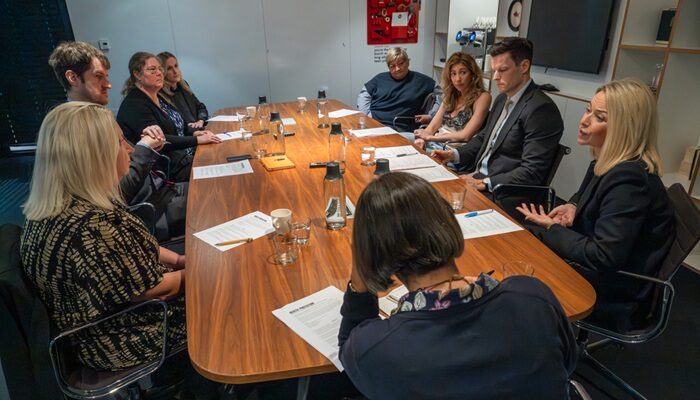
Finding new ways to engage with young people was a hot topic for our expert panel who met for Health & Protection’s Cancer Care in the Workplace roundtable in association with Perci Health.
Download the roundtable supplement by following this link.
A major challenge to educating young people about cancer is that younger adults often think they are invincible and that cancer is something that happens to older people and not them.
This is reinforced by many of the education and awareness programmes which are around cancers, such as breast cancer and prostate cancer, which typically develop when we get older.
But there are many of other types of cancer which younger people are at risk from.
Increased cancer rates among the young
“Most cancer services are directed towards older adults,” said Kelly McCabe, co-founder and CEO of Perci Health.
“But we are seeing certain types of cancer, such as bowel cancer, become quite rapidly more prevalent in younger groups of people under 40.
“There’s lot’s of research being dedicated to this and it’s likely to be multifactoral.
“However, an example could be childhood exposure to a toxin produced by E.coli, so an infection that is common in most people, could be contributing to the rise of bowel cancer in under-50s.
“There’s also very little education coming out about things like testicular cancer, colorectal cancers and some certain types of blood cancer. These are things which are more likely to affect young men,” she said.
Between the 1990s and 2018, cancer rates among 25- to 49-year-olds rose by 22%, according to Cancer Research UK. That is a bigger percentage change than in any other age group – more than double the 9% increase in over-75s.
Making men aware
Despite this rise, cancer awareness among the young remains low, said Morgan Fitzsimons, co-founder and chief experience officer at Perci Health.
“Our research among people aged 18 to 25 showed there was a general lack of knowledge and awareness about cancer with younger men especially not understanding what causes cancer.
“This is a big problem because we know that 40% of cancers are preventable through lifestyle changes,” said Fitzsimons.
“At the moment we’ve got this clinical trend that is heading downwards, but this behaviour trend where a group of people have absolutely no awareness about cancer and the impact their lifestyle has on it.”
Hugh Bennett, director of corporate at Howden Employee Benefits, agreed.
“That younger male culture is really difficult to penetrate – they’re often predisposed to negative lifestyle choices such as drinking alcohol, eating fast foods and being sedentary playing computer games,” he said.
“They understand that alcohol and smoking is bad and they probably will know someone who’s been affected by it, but it’s likely to be a grandparent.
“It’s not their mate who’s 20 and has just got cancer. It happens, but it’s rare so it’s not relatable,” he added.
Cultural change
There is also a tendency among some young people towards socially celebrated norms, said Bennett.
“One of the biggest things I battle with is people making light of not going to the gym, but having a bottle of wine instead,” Bennett continued.
“It becomes like a celebrated thing and that’s a problem,” he added.
That change in what is perceived as socially acceptable would be a great place to start, agreed Joy Waugh, senior consultant and marketplace lead at Zest.
“We need to focus on what is genuine wellbeing,” she said.
“You should be able to say I went to the gym, had a healthy meal and a good night’s sleep and that’s a good thing. Rather than just getting a takeaway a bottle of wine and sitting at home watching TV.
“We need to think about changing the narrative from celebrating the social norm to how we talk about what’s good for you and your family,” she added.
Catching cancer early
For young people, screening for things like cervical cancer and HPV vaccines are essential, with the HPV vaccine having a massive impact on a range of cancers.
Early detection of cancer has often focused on screening, but with more than 200 types of cancer, it is not possible to screen for everything.
So it’s important not to just rely on screening for detection.
“The vast majority of cancers will be detected via a GP, not via a screen, and sadly in the UK, a large proportion of cancers are being detected via A&E where the outcome is much poorer,” McCabe said.
“So how do we get people out of A&E and to GP, and that can be a virtual GP, and how do we get people to describe their symptoms in a clear way?”
The panel highlighted that knowing what your normal state of health is and what your lifestyle risks are was important.
Understanding this baseline means that if someone does become ill or is concerned about their health, they can clearly explain this to their GP.
“When you get to the GP you can very easily be fobbed off,” noted Rachel Western, principal at Aon.
“If you use a digital GP this can be even more so because they can’t physically see or feel anything, but if you can go along and say this is the issue, this is the family history, this is the concern, this is what I’m worried about and what are you going to do about it? Then the GP has a much clearer idea of what’s going on,” she said.
Communicating effectively
Younger people tend to use social media and digital platforms more than traditional forms of communication and it is therefore important to use these channels to reach them.
“If you think about the health information they are getting through social media, a lot of it is on subjects like neurodiversity and mental health,” said Megan Millar, senior associate workplace health consulting at Mercer Marsh Benefits.
“There is not a lot on cancer specifically for this age group, so it’s about understanding this demographic and then using the right channels to get those points across to this generation.”
Acknowledging this point, the panel highlighted that studies have shown there is a lot of misinformation about cancer online.
But they noted positivity in the increasing number of healthcare professionals who have a following online and who are creating digital content in a way that people want to experience it.
“They’re becoming influencers in their own right,” explained Perci Health’s Fitzsimons.
“The great thing about this is that you know the information is correct. They’re creating bite-sized content and it’s personalised,” she added.
Be relatable
Another good way to engage with younger audiences is through relatable stories.
“The statistics are scary, but people relate to somebody talking about their own story,” said Waugh.
“How it’s affected them, what the impact is on all the different areas of life with their family, with their friends, their social life, their workplace, their finances.
“It’s bringing that story together and being able to communicate that in a personal and relatable way,” she said.
Rebecca Rann, head of health at Benifex agreed, noting that in today’s culture celebrity stories can be particularly effective at raising awareness about cancer and encouraging people to have regular checks to help spot the early signs.
She highlighted Jade Goody who became a media personality after appearing on Big Brother. When she discovered she had advanced cervical cancer at the age of 27 the story hit the headlines and raised awareness of the condition.
“When someone’s story is in the media, you can see the impact; when Jade died it had a huge impact. It is finding those stories, but without there being any misinformation, making sure it’s relevant and it’s someone that people can relate to,” she concluded.
Download the roundtable supplement by following this link.