
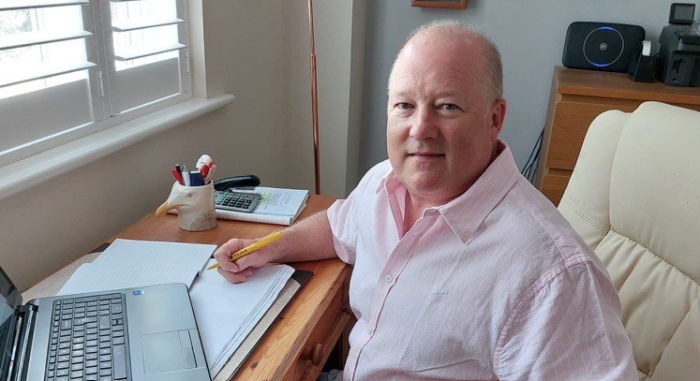
Andy Stephenson, a stalwart of the group risk sector who has just retired from his role as senior account manager at Aviva, speaks to Health & Protection about starting out as a life and pensions broker consultant three and a half decades ago.
He explains why narrowing his remit to just protection meant less can mean more, and why building long standing relationships has meant the world to him.
Stephenson also touches on standout achievements such as forming a group protection team at Aviva and taking a key role in product proposition launches at MetLife.
He also reflects on overcoming redundancy and the key challenges and opportunities driving the group risk market.
Starting out and specialising
“When I became a life and pensions broker consultant at Sun Alliance in 1989, there was a superb sales consultants training course run over several months in which I learned how to become a broker consultant,” Stephenson tells Health & Protection.
During this time Stephenson learned many aspects of the role from technical product knowledge, how to present, developing relationships, planning activity, organisation, closing deals and achieving targets.
“I was given my own panel of intermediaries to develop and secure new business opportunities, as well as be their main point of contact to resolve any issues and servicing of existing business,” he continues.
“There was a wide range of products, and this was my first introduction into the world of group protection.”
That introduction would eventually see Stephenson move on from Sun Alliance to a role specialising in group protection, a move he admits he found “daunting”.
“I wondered whether this may compromise my career development, however, I quickly learned that less can often mean more,” he continues.
“It takes courage to adapt to the concept of less, with a specialism in one market only.”
Developing relationships
While Stephenson regards all the segments of the group protection market as important, he reflects he was very fortunate to be responsible for developing the key relationships across many of the major intermediaries, such as Mercer, now Marsh, WTW, and Aon.
“It was always very satisfying working closely with intermediaries and internal colleagues to present options and solutions for clients, and especially the more diverse, larger organisations,” he says.
“I recall my first £100,000 per annum premium scheme, my first £1m per annum premium scheme – negotiating large deals was both satisfying and rewarding.
“While I have worked for a few providers, I have developed and maintained the strong relationships that are required across the key intermediaries.”
Hitting targets
While Stephenson has routinely hit his sales targets, he is mindful of the support he has received along the way.
“For me, a significant achievement is the level of support I received from these intermediaries throughout my career,” he continues.
“I do not recall a single year in which I didn’t achieve my targets – and the targets were high enough, believe me.
“So a standout achievement for me is the trust and relationships that I developed across the market that have been integral to the support I have received throughout my career.
“These long standing relationships mean the world to me.”
Consolidating group protection team
Elaborating on other standout achievements, Stephenson points to his time at Aviva and MetLife.
“When I first joined Aviva which was Norwich Union Healthcare at the time in April 2005, their group protection proposition was split between group income protection (GIP), group life assurance (GLA) and group critical illness (GCI),“ he explains.
“My aim was to bring these together to form a complete group protection team and proposition, which was not easy in a complex multi-sited organisation.
“This achievement did take some time, but we got there in the end – and this to me was a massive achievement.
“And while I was at MetLife, I was integral to the development of their GLA proposition, and also the successful launch of their GIP proposition too.
“Many of the key intermediaries supported this, and my relationships with them helped establish a great foundation for growth.”
Keys to success
In terms of what he has learned about himself over his long career, Stephenson reflects that the key to success is developing long-term, meaningful relationships.
“This doesn’t happen overnight, and is built on trust, transparency and understanding – be that of the intermediary and how they operate, the client, and also your internal colleagues, as well as of course technical knowledge too,” he continues.
“While there has been so much change in the industry over the years, especially new technology, for me it is still very much a people business.
“You may have the best product out there in the market, but without a strong relationship, you would struggle to be successful.
“Therefore the art of developing and maintaining those strong relationships, and being adaptive, are important strengths I have learned about.
“It is extremely important to deliver what you say or promise, and if things don’t go to plan, to resolve quickly and effectively.”
Building deeper understanding
But Stephenson adds that not worrying about the peaks and troughs that tend to characterise a career in sales has also been a key learning.
“While achieving targets each year is important, I learnt to build a deeper understanding of clients and intermediaries, knowing these opportunities would present themselves again in the renewal cycle,” he says.
“Being in distribution, it really is a roller-coaster effect, and I learnt not to be too worried in the dips.
“As long as you remain focussed on the opportunities ahead and continue strengthening those relationships, the business would come in.
“I learned about resilience and determination from a behavioural perspective to help my mind focus on the positives.
“I learned that a combination of technical expertise and relationships is key. And I learned how to navigate both internally and externally to get the best out of situations.”
Retaining resilience
That resilience has held Stephenson in good stead as he has been unfortunate enough to have been made redundant twice.
“Having the resilience to overcome setbacks and bounce back, you do learn a lot about yourself,” he continues.
“The sector has changed over the years – we have seen a lot of consolidation and acquisition across both providers and intermediaries.
“I do anticipate more of this to continue in the future, and that is another reason why those relationships are so crucial.”
Product development
A further significant trend, Stephenson points to, is how products and propositions have developed over the years.
This is especially true of the wellbeing space where there has been a major shift in focus to help employers with a more proactive, preventative approach to health and wellbeing.
Additional wellbeing services such as the EAP or digital GPs and health services have proved to be important to customers in developing wellbeing strategies, along with being more proactive around employee communication.
“For example, all of the additional wellbeing services that are included within group protection propositions are now vital for employers to be aware of, so that these services can be communicated and utilised effectively by their employees,” Stephenson explains.
“Ultimately these wellbeing services will help employers to save costs over the longer term.”
Significant growth ahead
As for the future of the protection sector, Stephenson adds that with bodies such as Grid raising awareness of the group protection market, there are significant growth opportunities ahead, especially in the SME market.
“However, with a shift from employers to focus on solutions, wellbeing support, earlier intervention and cost savings, the industry is well positioned to grow the market further,” he notes.
“While cost is important, I firmly believe in understanding client needs by asking the right questions, and broadening conversations away from pure price.
“Having a more consultative approach with clients can really help to develop this market further.”
Honesty and transparency
Asked about what he might regard as his mission over his career, Stephenson says this was always to ensure both intermediaries and clients received the best from himself and the insurer and to be the main point of contact for opportunities and resolution.
“I have always been honest and transparent with both intermediaries and clients, and delivered what I have said or agreed to, in effect being the ‘go to’ person for them in the market,” he continues.
“I have always tried to simplify technicalities with clients too, to ensure everything is clearly understood.
“Doing business with a smile on my face and being positive has been a mission of mine too.”
Missing banter and competition
As for his own future, while he will miss his colleagues, he has much planned.
“I will definitely miss the people and the banter, and having built up some great friends over the years, I fully intend to remain in touch,” he continues.
“However, I will miss the challenge of closing those deals, some of which take significant time due to additional complexities and the renewal cycle.
“I thrived in a competitive environment, and I’m sure adapting to retirement will take some time.
“In retirement, I plan to spend more time with my wife and family, with travel and holidays – there’s lots to explore.
“My wife already has a list of DIY jobs for me to do but I’ve been a keen sportsman throughout my life, so I intend to play more golf, watch Holbrook RFC when I can, and follow Brighton & Hove Albion FC across the country and Europe.”