
With ROI now a top priority, employers are struggling to measure the true value of cancer care and wellbeing support, writes Richard Browne.
One of the main things employers are looking for when it comes to workplace health and wellbeing is return on investment (ROI).
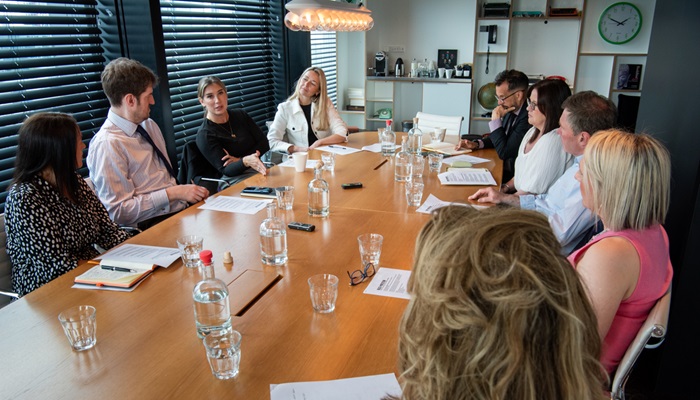
That was the view of participants at the Health & Protection Cancer care in the workplace roundtable in association with Perci Health.
With the unfortunate state of the NHS at the moment, it is one of the areas that seems to be coming under increasing pressure.
Download the roundtable supplement for the discussion by following this link.
ROI is a big request
Emily Jones, client consulting director at Broadstone kicked off the conversation and said: “We all have experience of the rising cost of insurance – so it is about really looking at ROI which is a big request from a lot of our financial directors.
“And its how do you articulate that – because it is really difficult to actually demonstrate the results of having all these various insurance policies and provisions in place, and the impact and the benefits of that.
“A lot of it is doing the analysis on where the starting position is and what we are looking at at the moment – what’s the absentee rate and doing that analysis before we even start, because there isn’t a magic calculator or a tool to do it.
“So a lot of it is piecemeal where you are pulling all that information together.
“More than ever the scrutiny is on the cost of these provisions and then justifying the benefits requirements and that’s a big challenge.”
Harder than ever
And the situation is not getting any easier either.
Jones reflected that she had been in the industry for 25 years “and it is harder than it has ever been.”
Beth Husted, associate director of health and benefits at WTW, agreed wholeheartedly and said: “The healthcare spend is blowing people’s minds.”
She said employers want to know “what can I do to offset that cost by some early intervention, screening or prevention?
“The screening and the intervention will help, but it is an upfront cost and you’re not going to see any dividends for another couple of years.
“So its really hard to sell and nobody wants to cut back because that’s an even worse story.
“But equally if you don’t get ahead of this and do some early stuff now, it is going to continue to get worse.”
One good point of contact
An important element is to have one good point of contact, according to Karen Smith, corporate team lead at Towergate.
“What we see with our clients is that it is really important we have got that one point of contact – because when you’re dealing with all of the benefits you need to get the actual breadth of knowledge of the client and how it is affecting all these benefits.
“So we can manage the client’s expectations that little bit more right at the start.
“We are doing some work with clients on prevention of cancer and we’re seeing that requested a lot.”
Start from the top
Clients are asking for specific screening too, Husted noted: “Clients are saying they want specific cancer screening, we want to do something on cancer awareness – how we can help our employees?
“Because not everybody takes out private medical insurance.
“So we’re in a bit of a cycle where we’ve got to sort of break somewhere to get out of, because private medical insurance (PMI) is still a really valuable employee benefit to give.
“When it comes to the cost breaking point – that’s where you get a feeling of being disheartened from the majority of employees, because they’re penalised on cost and the value then gets degraded.
“It is such a really good benefit that we’re offering – but by bringing all the benefits together and making them work together using the added value from all of the providers – then I think that makes the whole proposition work – understanding where those gaps are and looking at prevention, that starts to come through.
“But it has to start from the top”
Not a precise science
One of the biggest problems of thinking about ROI for insurance is that employers need to realise the length of the investment can be considerable, and therefore it may take longer for a return on investment than they would want.
John Dean, head of health and protection at Secondsight, was quite blunt in his view of the main issue facing the desire for a quick ROI, and asked a simple question: “How many of us would consider a five-year plan before seeing a return? Has anyone ever seen that anywhere in the world of work? No.
“You might get some enlightened, privately-owned firms who might say that – but it is a lucky day in the office when you see one of them.
“Most of them are looking at a return in the mid to short term, so that’s a challenge.
“I think risk is easier in some ways, because the rule sets around risk are easier, because they either cover management or they cover everybody.”
Then there is another problem, which is that half of the claims might be with people who are dependents and are not even working for the company.
But Dean noted that things can change quickly when cancer hits the management team.
“Suddenly you find the chief execs or someone in the business has suffered cancer, and HR will see the need for investment – but actually it is a reaction to something that might have happened in the past.”
The end result is very different approaches from different employers.
“Some are just hoping, fingers crossed, that the increase in insurance will be less than 6% – in which case I’ll just put it in the bag and go ‘whew’ and deal with that next year. Then others are much more enlightened,” Dean continued.
“But its not a precise science.
“Obviously the bigger clients are actually easier – when you’ve got 4,000 employees or more, you’ve got something you can grab hold of, you can get some data that’s relevant and you can look at things.
“But get a typical 200-person company and it can be a different story, as there isn’t enough data.
“You can do it – but It needs to be super large clients when you’re doing data driven analysis.”
Increasing costs
Meanwhile, the cost of insurance is ever increasing.
Dean emphasised: “We’ve got to change because you can’t go forward five years and, and even my maths at 10% knows that in the next five years, a healthcare scheme for a single person is going to cost more than a pension in the UK.
“So we can’t carry on like this.
“We’ve got to look at doing things differently, and we’ve got to get to part-funding schemes where the corporate company will pay some of it, allowing employees to top-up.”
Download the roundtable supplement for the discussion by following this link.