Getting more women an earlier breast cancer diagnosis could save around £23.5m.
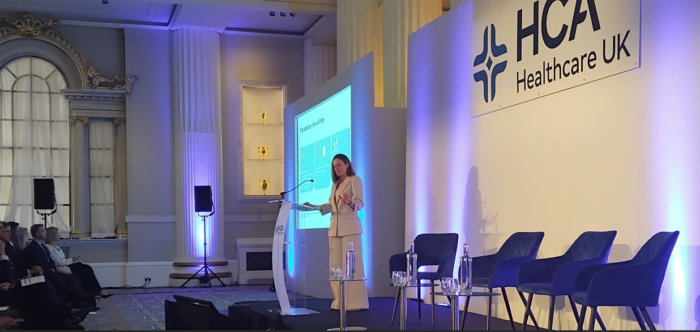
This is according to Dr Kathryn Oakland, medical director at HCA (pictured), who was addressing delegates at the Where is cancer care today and where it is heading tomorrow? conference organised by the provider at Mansion House in London yesterday.
Oakland told delegates that the cost of treating a locally advanced breast cancer is around £5,500 to £8,000 per patient per year more expensive than a simpler treatment pathway.
While a typical treatment pathway for a patient with an earlier breast cancer diagnosis would include breast conserving surgery, radiotherapy and chemotherapy, a more complex journey would be longer and include chemotherapy for some, followed by more radical surgery – mastectomy and potentially reconstruction and then radiotherapy and potentially more chemotherapy.
Cost savings
Using NHS costing and data from the national breast cancer audit – a study of more than 135,000 women modelling that through HCA’s data, Oakland explained that around 4% of women would be diagnosed with locally advanced breast cancer compared with just 1% at HCA.
“If you apply that to the NHS broader population, that’s around 4,000 patients,” Oakland said.
“So moving 4,000 women from the left hand side of that chart to the right hand side may be a cost saving of just over £23m to the NHS in the first year alone.”
Earlier diagnosis
But Oakland also pointed out that patients who have a direct to test at HCA are more likely to be diagnosed with an early invasive breast cancer in comparison with national audit data.
“And you may say, the differences between stages 1 to 3a, is that really significant? Yes, stage directly influences survival.
“If you have a woman diagnosed with an early stage 1 breast cancer, her five-year survival is around 98% – nearly double that of a woman diagnosed with stage 3 breast cancer,” Oakland added.
Survival rates
Oakland maintained that getting women into breast cancer diagnostics quickly also definitely influences their chances of survival.
“You’ve heard about the faster diagnostic standard and the 31 day standard for cancer treatment and again, using the same breast cancer data set, we can benchmark ourselves against the NHS,” she continued.
“The target in the NHS between referral and consultation is 10 days. At HCA it’s two days. And we do this 94.5% of the time.”
Best in class option
Oakland explained that the best-in-class option for women presenting with breast lump is to have a triple assessment.
“This is three modalities and intervention in one visit,” she continued. “Clinical assessment, imaging, biopsy.
“And the guidance is that it should be offered to all women.
“We offer it to all and we deliver it to 95% of women. In contrast, the NHS is doing this at about 68%.”
Faster diagnosis standard
Touching on the 28 day faster diagnosis standard, a target set by the NHS to ensure patients receive a diagnosis or have cancer ruled out within 28 days of referral, Oakland added the national data shows that around two-thirds of women are meeting this metric for breast cancer.
“At HCA, it’s 99.5%,” she continued.
“With the 31 day treatment standard, the NHS is better at this. They’re able to do this 92.5% of the time versus a target of 96%.
“We’re meeting this target and going beyond it. We’re able to do this 97% of the time.”