
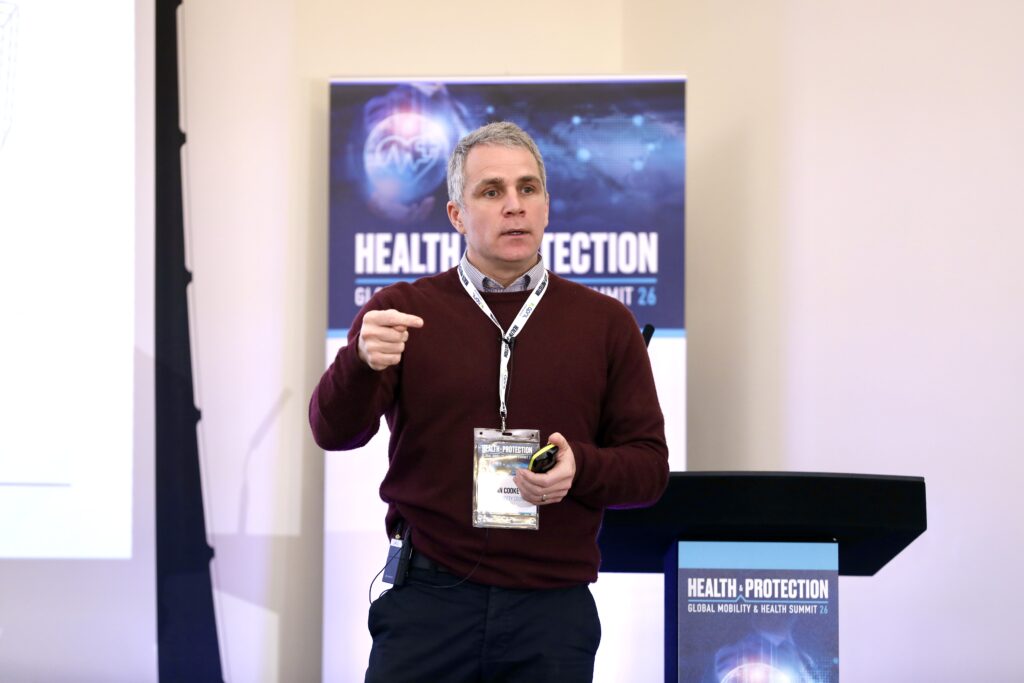
Wellbeing and mental health are being undersold as a business risk, Health & Protection’s Global Mobility and Health Summit’s was told.
This was the view of Ian Cooke, audit, consultancy and culture change director at the British Safety Council, when discussing how mental health challenges should be addressed in the workplace.
Despite business disruptions being at a macro level, all the fatal and serious incidents he has investigated had a causal line linked to human error.
This is why Cooke sees a direct link between employee wellbeing and mental health and business disruption.
“You can engineer-out risk, put processes and procedures in place and train people to understand them, but when incidents still occur you often find there is a human behavioural element involved.
“A big part of behaviour is going to be your mental wellbeing, your thinking, your thought process,” he added.
Number 16
Yet such an issue is overlooked by many businesses when managing risk.
A survey by the Business Continuity Institute discovered that safety was not in the top 10 risks that senior leaders believe will threaten their business in the next decade.
“When you look back at the past 10 years at what has caused business disruption, safety incidents was number one,” Cooke said.
“It may not have grabbed the headlines,” he added, “despite the many incidents occurring within business involving somebody off sick with stress or a workplace injury or fatality.
“If anyone has been involved in a serious incident, you will know the impact it will have on that business.
“But when you ask leaders what they are planning for, protecting their business against safety is number 16.”
Under pressure
Stress and anxiety do not just effect people working in high-risk industries, such as oil and gas, construction and mining. Cooke said high levels of stress and anxiety are also found in social work, administration and roles connected to IT.
Technological advancements are partly to blame. “Computers are getting faster at processing information and can turn out data quicker than we can process it ourselves,” Cooke said.
“This is adding to the mental health challenge within the workplace.
“Pressure is good for performance, but when it rises to a certain point you start to see strain and stresses,” he added.
“Processing too much information puts too much pressure on individuals and you start to see the physical and psychological effects.
“We have to take into account the human when designing systems and working environments, otherwise the information gets lost, missed and they make rushed decisions.
“Most of the organisations that have carried out incident investigations where human behaviour was a significant part of the accident have developed processed by which they limit the amount of information workers are required to follow.”
Cooke advised that another area companies should focus on is building relationships to manage pressure within a team.
“Create an environmental where people feel part of a team and part of a collective,” he said.