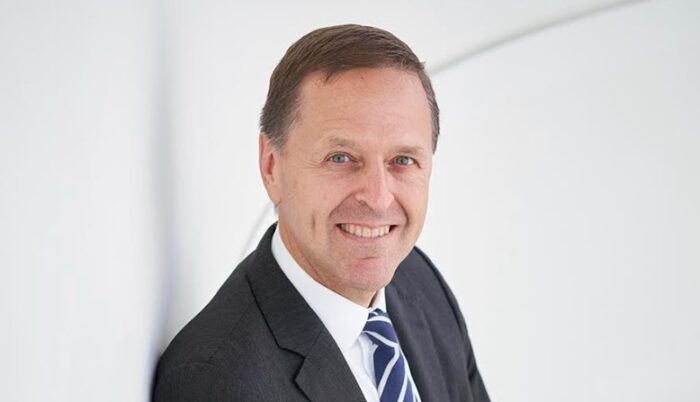
A year on from taking the helm as Simplyhealth’s CEO, Paul Schreier (pictured), speaks to Health & Protection about why purpose and potential were key factors for him becoming the firm’s CEO and how improving access to healthcare for customers has driven development of its product range.
He also discusses his hopes for the company’s new business, Practi, and why pursuing strategic growth will maintain the health plan provider’s market leading positions.
Purpose and potential
“There are two things that really that played into my taking the role,” Schreier (pictured) tells Health & Protection.
“One was the purpose of the organisation and the other was the potential,” Schrier adds.
That purpose is to improve healthcare for everyone in the UK, Schreier explains.
“So it’s a pretty straightforward idea,” Schreier continues.
“We measure that actually by how many people we’re helping do that, so that’s one of our most important things that we look at internally to understand whether we’re doing what we think we should be doing.
“And that purpose, in slightly different wording, has been around for 150 years. The firm’s antecedents go back quite a long way.”
Running through entire career
Before joining Simplyhealth, Schreier was an interim CEO at global charitable foundation Wellcome Trust where he led its efforts on Covid-19 treatments.
Prior to that his career included several years in academia as deputy vice-chancellor and chief operating officer at Macquarie University in Sydney, Australia. His wide-ranging career also included six years in the Royal Navy, followed by nine years at McKinsey & Company where he became a partner.
After that he was appointed to the Australian Department of the Prime Minister and Cabinet, becoming deputy secretary with responsibility for economic policy and strategy.
But running through these myriad roles has been that commitment to purpose, Schreier says.
“I’ve had a number of different facets of my career, commercial roles, non-commercial roles, I’ve been in the public and private sector, the military and all the rest of it, but it’s always the that purpose that runs throughout,” Schreier says.
“That was very attractive. That combination of purpose and potential.”
But the potential of the business has also been a key driver to taking up the role.
“Potential is you may argue in some ways what you haven’t actually achieved yet,” he continues.
“The business is doing nicely. It’s growing. It’s profitable.
“And I see a good future for the business.
“So if you wrap those two things together, that was it.”
Sustainable growth
As Schreier marks a year into the job, he points out that as Simplyhealth has no shareholders, all profits are ploughed back in to meet its company purpose of improving access to healthcare for its members.
“We are a business,” Schreier says. “We don’t have shareholders which is nice aspect related to our purpose.
“So anything we make, we plough back in for our members.
“Nonetheless, that doesn’t mean we’re a charity either.
“We’re a commercial organisation and we need to run a sustainable business with a decent modest margin in order to invest in new products, but also service and the underlying technology – especially technology that you need in any modern business – in order to have a business that’s sustainable for the future.”
Fundamental purpose
A key component to delivering that growth is Simplyhealth’s development of its product range.
This has involved its move to offering a health plan, while it also offers dental plans to individuals through the Denplan part of its business.
But elaborating on Simplyhealth’s health plan offering, Schreier says its development goes back to the firm’s “fundamental” purpose.
“So one of the ways we’ve done that traditionally over a long period is through providing insurance methods to be able to access everyday healthcare needs,” he says.
“It could be dentistry. That might be glasses that I’m wearing today. It could be something in the diagnostics. It could be primary care.
“There are different offerings there.
“That’s been something we’ve done for a while.
“But what we’ve done is that we’ve added to the mix of things we offer in that set of products.”
This has included an emphasis on mental health, women’s health and neurodivergent offerings.
“There are lots of different things that have been added into the mix to enable our customers to pick and choose things they need for their own health,” Schreier says.
“And in many cases they can pick those things and then that gets back into their insurance, so glasses would be an example of that.
“For example, if the customer wants to pick glasses they can go to our partner company – they get a discount when they get the glasses. They can also back it up with insurance and that’s great for them.”
Diagnostic testing
The flexibility of the offering also means customers can pay for Simplyhealth’s arrangements directly, Schreier adds.
“It could be some diagnostic testing and things like that,” he continues.
“So through different methods we’re trying to improve all the time the ability of customers to access healthcare by identifying what they need and then pointing them in the right direction to trusted partners to be able to do that.”
Whole of workforce solutions
And that philosophy is informed by a “whole of workforce” approach, Schreier says.
“Right now we’ve launched new products in our health plan business which we call internally the whole of the workforce product,” he continues.
“And those words matter.
“Whole – everything we’re doing is looking to have a product that can be accessed by everybody.
“That’s absolutely critical to what we do.”
But that also means the offering must be affordable within the marketplace, he stresses.
“We have a product called Simply Essentials and that starts around £3 a month per employee and that gets to things that we know, and the evidence shows, are the things that are most likely if they’re not addressed, to cause someone, if they’re not addressed, to take time off work.”
Simply Essentials focuses on the three key issues causing workers to fall out of the workplace, that of access to a GP and mental health and musculoskeletal support.
“The inability to access GPs is one of them – hence the virtual GP service,” Schreier says.
“Mental health conditions are another. That could be anxiety. It could be depression. It could be some other form of mental health condition, so services around that.
“And then musculoskeletal support whether it be a bad back, sore shoulder, or something around the desk.”
But Schreier acknowledges these issues vary depending on workplace and role.
“If you’re loading bags at Heathrow Airport, it’s a very different risk if like me you have a relatively sedentary lifestyle by comparison,” he points out.
“If you can get to those things, and that’s what the Simply Essentials product does, then you’re going to have a better than even chance of stopping in the first instance someone from taking time off work in the first place, but then also returning them to work rapidly.
“Because the key here is early diagnosis and early attention on these things. That’s absolutely critical.
“So that’s the biggest single innovation in the product set happening right now. That product is in the market. It’s very new.
“And it’s getting good traction too, which is good to see.”
Speed of access
A key development in facilitating that quicker return to work has been the firm’s Simply on-demand offering.
“What that does is ,through an app, enable you to access a whole range of other services with our trusted health partners,” Schreier explains.
“It could be aspects of women’s health, men’s health, diagnostics around MRI scanning or whatever is needed if it’s a musculoskeletal related condition.
“There are dozens of different things here.
“And the whole point is to enable our customers to navigate that, to find what they need quickly.
“If you’re going to get access, you need to figure out what you need first and then you need to find someone who can do it for you.
“And ultimately you need to fund it, so on-demand is looking to improve the first of those things.”
Preparation to launch
Product testing also played an important part in ensuring the offerings resonated with customers, according to Schreier.
“We did a lot of work to really understand what those requirements were.
“We tested it extensively and then we played the product into the market to take into account of what we learned there.”
Consumer versus employer need
This product testing imparted the lesson that consumer interests and that of their employers do not always correlate.
“At the consumer level, consumers have broader interests than an employer might have,” Schreier explains.
“So for example, it would be relatively rare for someone to not come to work because of a lack of glasses. So glasses would not figure highly on the work absence list of things.
“But consumers value it a lot and so through our broader offering, things like that are on the table.
“There probably is dental absence from work, albeit not the number one driver,” Schreier continues.
“We’ve talked about the three biggest areas already, but consumers value the other benefits hugely because if you’re at work, you’ve got lots of bills, you’ve got cost of living pressures and so on, you’ve got to manage your cashflow carefully.
“The ability to spread the cost on things like glasses or on dental care on a diagnostic of some form, some form of primary treatment is enormously valuable to you.
“So when you’re doing something like a new product development, it’s about trying to find out exactly what a customer needs by going and asking, talking, surveying, doing proper work on product development and then delivering it at a price where the customer derives value.”
Maintaining market leading positions
While Schreier describes Simplyhealth’s health plan and Denplan offerings as market leading, he harbours hopes that the firm’s third business can follow suit.
“The third business, Practi, helps people in the dental setting understand what a piece of treatment looks like for them and then to find financing for it if they need it to be delivered,” Schreier explains.
“And that’s a new business. That opened about when I joined. It’s growing rapidly. It’s a very nice business. So those are the three things.
“That business is small and growing.
“I’d love to see Practi extend its services, not just for dentistry, but also for financing other aspects of healthcare as part of its future, but it’s early days.”
Schreier also promises innovation across Simplyhealth’s entire product range.
“We’re not done with that,” he says. “So there’s quite a lot to do on the product side, quite a lot of innovation to come.
“But of course as we have customers accessing the different services that we provide through that on-demand network, we’ll start to understand our customers more.
“And we’re adding new services all the time into that mix. That’s one form of product enhancement for us.
“Whether it be an insurance related solutions or through financing solutions or on-demand type arrangements, we’re looking to help people fund their services as well while retaining that key affordability.”