
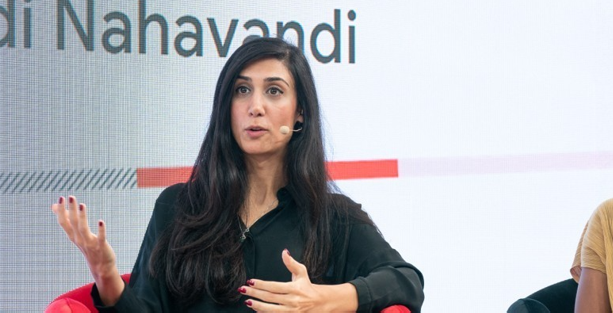
Tuune founder Shardi Nahavandi launched the women’s health digital diagnosis platform after being incorrectly diagnosed with bowel cancer.
At a special briefing in the City of London this morning, Nahavandi (pictured) explained her journey towards doing her own research and finding out her problem was hormonal and could be treated with the right drugs, how the platform aims to diagnose women’s health more effectively and why pharmacies have proven the early adopters of Tuune.
Tuune is a class 1 medical device which identifies hormonal conditions and prescribes medication.
Studying health technology
Its founder Shardi Nahavandi revealed she bucked the trend within her family who are predominantly engineers to go and study health technology and management before working for a genetics sequencing company.
Severe health problems
But halfway through her degree, she discovered that she started having severe health problems.
“I literally couldn’t eat anything,” Nahavandi said. “I couldn’t go to the bathroom.
“If I had to, I had to run. I was losing hair. I was going completely bald. Drinking water was painful.
“I had a lot of very unpleasant symptoms that I’m not going to get into.”
Losing hope
While Nahavandi added that she is a big believer in seeing a number of doctors to identify a health issue, it was upon seeing her ninth doctor that she started losing hope.
“The gastroenterologist said I think you have bowel cancer – let’s do a biopsy and if we need to, we’ll do surgery afterwards,” she continued.
“A couple of days later we did a biopsy and a couple of days later he came back to me and said, I’m so sorry, but I have no idea what you have.
“You don’t have bowel cancer, but I’ve no idea what it is.
“And I said, I have zero quality of life here. What is actually going on here?”
“I can’t eat, sleep or sit. What the hell is actually wrong?”
Self study
While at the time Nahavandi was told that she could consider yoga or meditation, in her ill health, she decided upon writing her dissertation on herself.
“Through measuring cortisone levels, I landed on female hormones – Estrogen etc and their relationship to it,” she continued.
“So I went to my professor and I said I want to focus more on female hormones and understand that better and change my dissertation.
“They said, I wouldn’t focus on that. I don’t think you’re going to get a good grade.
“I said, what are you talking about dude? If anything I started screaming at him.
“And just said, I’m just going to write it and if you’re going to fail me, you fail me. I don’t care.”
Conducting research
Consequently, Nahavandi revealed she started her research and read hundreds of research papers and then finished her dissertation.
“I hadn’t really got an answer,” she continued. “So I decided to do a Masters in Endocrinology which is the study of hormones as I needed to understand this field better.
“And so I get to the reproductive module and this is a medicine angle rather than a science angle and all I’m learning is cancer, breast cancer, ovarian cancer.”
Looking into hormones
Nahavandi added that she realised that no-one was talking about hormones and how they function in women.
“I looked back at the research papers with a different focus,” Nahavandi continued. “At that point it felt like I read thousands of papers. It wasn’t thousands.
“I landed on 200 or 250 papers that said I had a particular hormone balance that impacts the way I metabolise.
“But because I didn’t fall into whatever category of the medical system in order to categorise me as, they just couldn’t figure out that my symptoms were hormonal related.”
Self diagnosis
Eventually Nahavandi hit upon a drug that was not mainstream at the time that had quite a lot of evidence behind it for someone with her symptoms.
“I went to my GP, printed out a bunch of papers and said, this is the diagnosis. This is the drug I should take. Here is the evidence. What do you think?
“I was literally told, who do you think you are? Do you think you Google things before you come here?”
Family friend
But thankfully Nahavandi found a family friend in Germany, a gynaecologist, who could make the diagnosis.
“Fast forward a couple of years, now I tell my doctor, this is what you prescribe to me,” Nahavandi continued.
“This is the dose that I take. And then I constantly just tweak the dose.
“But the drug did become a guideline drug to be prescribed,” Nahavandi said.
Launching Tuune
Nahavandi concluded that not enough research is carried out on women’s health across the world which is why she launched Tuune.
She explained that the platform uses algorithms trained on the highest quality scientific literature and clinical data to diagnose conditions through an online assessment looking at 70 symptoms across women’s hormonal health from menopause to contraception to fertility.
The platform then matches the symptoms to the relevant drug approved by regulators to give women an understanding of what is going on, explain the pros and cons of the medications and help them make better informed decisions.
An online assessment triages patients into different categories including ‘safe’ where no face to face interaction with a provider is necessary, medium risk and higher risk to work out the right medication, treatment and prescription.
Working with pharmacies
Looking ahead, Nahavandi revealed that while Tuune is seeking to eventually roll out the platform to employers, it is currently being used by pharmacies.
“It’s definitely not easy to work with the NHS and the NHS isn’t equipped to work with us yet, but pharmacies are trying to do more and more in an effort to take the burden away from the primary care system,” Nahavandi said.
“However, they feel very insecure, very out of their depth to do this and so here we come in.
“We educate them on why you’re making this diagnosis. Here is all this evidence backing why a certain diagnosis is happening and here is all this evidence why a certain medication was prescribed.
“So we have that relationship.”