
Insurers should prioritise improving the mental health of young people, building trust in healthcare and putting humans back at the centre of insurance, Sir Charlie Mayfield has said.
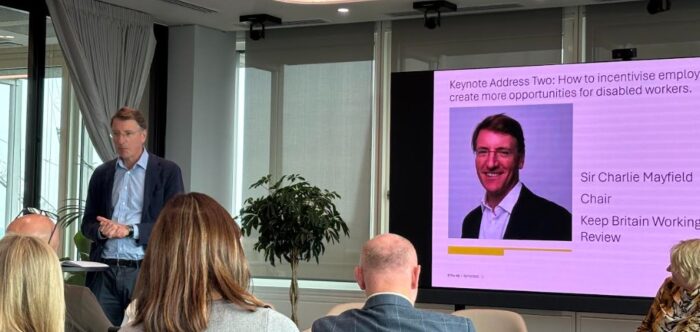
Sir Charlie (pictured), who is leading the government’s Keep Britain Working Review, emphasised the importance of innovation from insurers and focusing on people interactions.
Speaking at the Association of British Insurers (ABI) Keep Britain Working conference, the former chairman of John Lewis had already challenged insurance providers to develop risk pooling for SMEs to enable their employees to gain access to affordable health and wellbeing benefits.
Tremendous scope to innovate
But Sir Charlie also told delegates there was also “tremendous” scope for insurers to innovate.
When asked by Health & Protection which areas of innovation he would most like providers to work on to most effectively tackle the issue of labour market inactivity, he pointed to young people’s mental health and making insurance more “human centred”.
“Mental health among young people is a really, really important area,” Sir Charlie said, adding technology offered easily accessible innovations that can help with some of that.
“The question is how do we deploy it and make it relevant to people? So that would be one.”
System breakdowns and improving trust
Sir Charlie also noted a tremendous amount of fear in the market which he said created distance between people and that there were breakdowns in the system.
“I’m not sure I’d even call it a system,” he continued.
“Things like fit notes for example, exacerbate distance between people just at the point when they need to be staying in touch.
“This is a very human problem that has been turned into a question of risks and minimising risks and it becomes adversarial and very procedural and we need to turn the clock to make it a bit more human centred.
“So again, anything you can do to personalise, to connect people to create the mechanisms which support that and encourage it, the better frankly.”
Sir Charlie added that trust was also a key element.
“A lot of access to current healthcare is often through HR which sometimes is fine,” he continued.
“For quite a lot of people the starting premise is that it’s not something they can really trust and again, I don’t think it should be that way.
“But there are probably opportunities for us to claw back that aspect of trust by creating more direct pathways to access support wherever possible.”