Sharing data and experiences is even more important for multinational organisations when resources are tight, writes Owain Thomas.
Combining knowledge and insight by working with service providers is often a key approach for organisations with employees placed around the world.
However in the inter-governmental (IGO), non-governmental (NGO) and governmental sector where resources can be more limited, working with similar bodies is potentially even more important and beneficial.
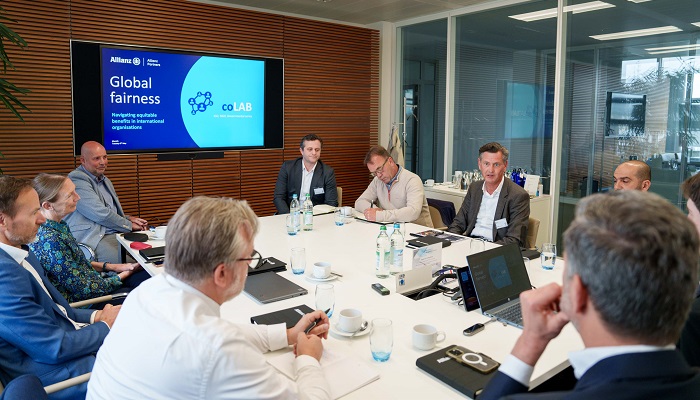
As the Health & Protection roundtable in association with Allianz Partners heard, where organisations have similar missions, finding common ground and working together is a welcome situation.
Download the roundtable supplement for the discussion by following this link.
Given their funding arrangements, IGO and NGO organisations can have highly volatile income streams which places pressure on management and continued operations.
For example, the significant cuts to USAID being made this year are one illustration of how funding sources can disappear almost overnight, leaving critical decisions to be made.
“In the NGO world we know we have to deal with whatever the geopolitical environment is,” said Nicolas Hubé, head of compensation and benefits at the Aga Khan Development Network.
“There is nothing we can do, we are impacted, or the beneficiaries are impacted, or our staff are impacted; we do the best we can.
“For some NGOs it’s been dramatic, so we just adapt, there’s nothing we can really do.”
As attendees pointed out, when this happens it is the core mission tasks which are understandably given priority and things such as improving or equalising healthcare benefits are left behind.
This can be disruptive in many ways because making significant benefits changes can take many years of planning, only for them to be shelved quickly.
And this can have knock-on effects to supporting providers, potentially slowing down their activities along with the sector itself.
As David Myers, global head of sales and key account management – health at Allianz Partners noted: “It won’t automatically revert as soon as the four years is done, because that’s not really the way the world works.
“But the longer-term direction of travel doesn’t really change, we just end up a bit reset because the period might finish, but I suspect we’ve moved a bit.”
Collaboration and economies of scale
However there was a desire to bring like-minded organisations together and lean on each other, rather than just on service providers.
And this collaboration could bring economies of scale and better coverage along with knowledge and expertise sharing.
“So far we put a lot on the insurance industry’s shoulders, but there is probably more we could do ourselves as an NGO community,” Hubé continued.
“If we are 20 staff in one country, you’re 100 in the same country, and we find a couple of other organisations there, we can quickly come up with a base of maybe 1,000 staff locally.
“But that means we would need to move away from a client to an insurer mindset, because who’s responsible if the claims experience is bad? It doesn’t mean it can’t be looked at, but it’s all changed that mindset of how we manage insurance cover and benefit plans.
“If you start having common cover and common responsibility across organisations that have different governance mechanisms and different funding mechanisms, how do you maintain some protection as well for that?”
Attendees noted there were smaller scale collaborative bodies but there could be an opportunity for these to be expanded and deepened to start exploring the possibilities of working together.
And Hendrik Boelens, head of IGO, NGO, governmental segments, international health at Allianz Partners agreed this was something the insurer could work with.
“Technically as insurers, if our underwriters are shown a membership of 1,000 instead of 20 in that country and the vehicle sits behind and basically recognises the risk pool, I don’t think there would be a particularly negative view on engaging or committing on an insurance view,” he said.
Stop reinventing the wheel
It was appreciated that for some organisations and sectors, potentially national governmental ones, pooling with other bodies or nations may not be feasible or legally possible, but there was recognition of the opportunity this brought elsewhere.
Furthermore, the amount of work duplicated across the sector in finding solutions to healthcare problems for staff was also acknowledged and the value of information sharing here was recognised.
“I got a big complaint from our staff in Libya that we did not have hospitals for them to use there,” said Aziz Sinan, head of insurance department at the Ministry of Foreign Affairs Iraq.
“I told them it wasn’t the insurer’s fault, they can’t build hospitals, but I was able to find a solution.
“I opened-up Tunisia for them and told them to just go to Tunisia, but this is just one case I faced. Imagine in the whole world, there’s lots of countries, they don’t have medical facilities available.”
This was a common theme and problem, as Bertil Postema, international insurance advisor at Médecins Sans Frontières agreed.
“And we did the same, and we all reinvent the wheel again, for your country, for our organisation, your organisation,” he said.
As Allianz Partners’ Myers noted, there could be hurdles around competition law but there was merit in working towards common goals.
“Some of those discussion points are quite tricky,” he said.
“But what I do agree with is ultimately in some of these areas, be it the NGOs working together to pool or the partnership approach and collaboration between them, that is probably the future.
“Everyone’s still somewhat operating in their little world rather than coming together at the moment.”
Data expertise
However, there was one use case where attendees were keen to rely on the expertise and detachment of insurers and advice firms – data sharing and analysis.
This was partly driven by a need for practical expertise in the area, but mostly to avoid data protection issues and ensure any insight was correctly applied to their organisations.
“I would like someone on our behalf, because of privacy reasons, to have access to everything relating to the healthcare of our staff globally,” said Hubé.
“Someone using technology and their expertise who would be able to feed into us and say we need to know about that and we should do that because of this.
“It would be difficult as an employer to manage those data ourselves for privacy reasons, and in the past the amount of data you could manage was also a constraint. But today with technology the amount of data is not an issue anymore, so let’s have somebody manage that for us.
“Brokers and administrators have a critical role to play because they are really in between and so they can protect privacy. They can really spot issues or trends or risk that need to be addressed; they can just manage that balanced approach and make sure the issues surfacing are not hidden because it will serve one side or the other.”
The potential of then having anonymised organisation data was welcomed but there was a request for more sharing where potential fraud or other malpractice was concerned.
As employers the attendees wanted identifiable information when there were questions about whether claims being made were accurate to enable disciplinary processes where necessary.
But there was also an acknowledgement that some medical practitioners and facilities could be complicit in fraudulent activity and information about those would be appreciated.
When asked if an information sharing facility for these organisations to understand what regions, or particular facilities, or doctors were less trustworthy or questionable, the answer was a unanimous “yes”.
Download the roundtable supplement for the discussion by following this link.