
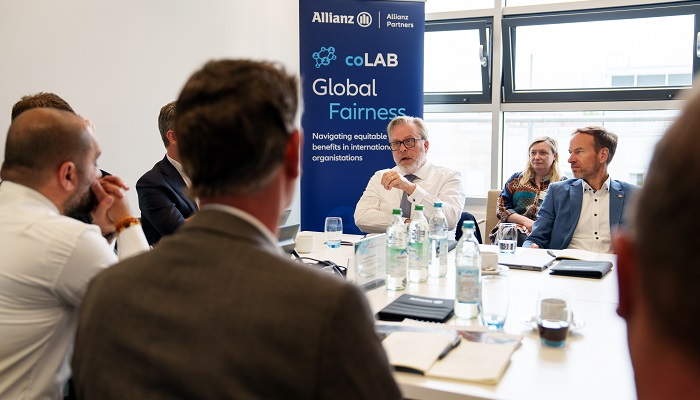
Matching equality with organisational values in global health benefits is not as easy as it seems, hears Owain Thomas.
Equality and equity of benefits is one of the pressing demands for multinational employers, particularly in regard to health insurance benefits.
Organisations have been seeking ways to even up their benefits while their workforces are frequently undergoing notable changes.
However, as the Health & Protection roundtable in association with Allianz Partners heard, what equality means and the range of benefits covered can vary greatly between organisations – particularly so in the governmental, intergovernmental (IGO) and non-governmental (NGO) sector.
Download the roundtable supplement for the discussion by following this link.
As attendees agreed, with salaries often below those found in the private sector, organisations and their employees are more driven by their mission goals and that feeds in to their workplace benefits as well.
For governmental departments those benefits and strategic aims can come in the form of legislation and legal requirements mandating what can and cannot be done or offered.
As Aziz Sinan, head of insurance department at the Ministry of Foreign Affairs Iraq explained, that can be particularly tricky when supporting employees in widely different locations such as New York or North Africa.
“That’s the hardest thing to manage; how do we convince them of the fairness between the two of them?” he said.
On an equal footing
Transparency and openness in communication is critical here and while employees may not like their new posting, they are at least on equal footing in many regards, with salaries no different in any locations.
“Well tell them they got posted to Libya and have the same salary as the counterpart in the UK, but the lifestyle of course is different,” Sinan continued.
“In Libya, you’re saving half of your salary while the one who works in the UK is not saving anything, so it’s a balance.”
That equal treatment continues into the healthcare provision with the coverage plans being very similar throughout the department.
“The plans are all similar from the minister himself and all of us have the same plan with the same level of benefits depending where they are,” Sinan explained.
“That’s why we seek an international insurer, because for example if our people in Mauritania can’t find a place in an emergency or for critical medical issues, they can travel elsewhere for surgery. If we use local insurance companies that ability to travel doesn’t exist, so that’s why we always use international providers.
“But it’s not only about the surgeries, there are also daily medical needs and it’s hard for them to drive five or six hours or take a flight in that case because it’s going to be on their own cost,” he added.
Cultural standards
For Médecins Sans Frontières (MSF) the organisation has spent considerable time and energy creating its overall benefits and reward strategy and is now rolling it out.
The aim is to be transparent on salary structures and benefits to share information and make as much detail available as possible – although there is an acknowledgement that not everyone will be happy.
In terms of pay, MSF wants to apply the same principles under the foundation of its structure and when conducting benchmarks, does so against the relevant particular sector that it is comparing with.
This focus on the process of how to judge pay makes quite defined boundaries to begin with for the organisation.
The approach to benefits has involved long discussions about whether to have minimum standards which can have freedom to be adapted, or a standard for everyone.
Eventually the organisation’s leaders agreed that culturally it would be difficult to have people on different levels of benefits, so arrived at the minimum standard for everybody across the board in all countries – a process which took several years.
As attendees pointed out, while updating benefit levels to recognise new treatments and new expectations can prove tricky, it is typically fitting the range of employees that causes the greatest headaches.
Employees at head offices often have different expectations and legal requirements compared to those on international placements and these can then vary greatly with locally employed and regulated people in host countries.
A commonly cited factor was wanting to do the right thing by their employees but also recognising that employees’ individual circumstances might not fit that desire or cultural approach.
Ethical approach
Nicolas Hubé, head of compensation and benefits at the Aga Khan Development Network explained, for that organisation everything has to be aligned with its cultural norms and values.
With the range of sectors and locations the network is involved in it creates a vastly different and more localised benefits design, but which is led by the ethical approach.
Hubé, like the team at MSF, therefore puts more focus “on the how, rather than the what”.
“The content of the plan, whether they put more focus on life or medical or retirement, is up to the local network organisation to decide and if they want to split the cost between the employer and employee, because it has to be aligned with their market, with their values,” he said.
“My role is to make sure they follow the thought process and they’re looking at their important things and they don’t lose track.
“For instance, we made a policy decision worldwide that death in service is not a risk people should self-insure for, so our network firms have to buy insurance for the local staff.
“Our policy is if somebody dies, we give 12 months of pay as a minimum, but if they want to put 12 months, 16 months or four years of salary, that’s for them to decide.”
As part of this Hubé has conducted an inventory of all local benefit programmes from the network organisations and shared that back to all of them, building the mindset of sharing and being transparent among the network.
“I found in many countries they were having benefits for executives, benefits for middle management, benefits for blue collar workers.
“So I said they needed to work on those benefits. I mean, the health of an employee doesn’t depend on their salary level.
“We do update that inventory every two years so if nothing moves, I will remind them it has to be on the agenda, they need to get rid of those categories of employee benefits and other things.”
Worker wellbeing
But perhaps more deeply connected to this ethical stance is the wellbeing of their people, away from the theatre of insured health benefits.
For an organisation that is dedicated to improving the quality of life of those in need, mainly in Asia and Africa, the tools and actions it takes are different from wellbeing in the Western world.
“When Pakistan went through that peak in inflation, when there was the flood and access to food became scarce, to support the wellbeing of staff in Pakistan the Aga Khan University in Karachi, provided its 14,000 employees with three meals per day and allowed people to take one meal back home,” Hubé said.
There is also a heavily subsidised grocery store on site, free loans to buy motorcycles were made available and an app for commuting to reduce fuel expense of employees.
“Promoting wellbeing is the overarching thing but you need to find the right tools that are relevant to the context and the population. If you’re dealing with chefs and cooks and cleaning ladies in a hospital in Nairobi, you need to find other ways to support wellbeing, it’s a different thing,” he concluded.
Download the roundtable supplement for the discussion by following this link.