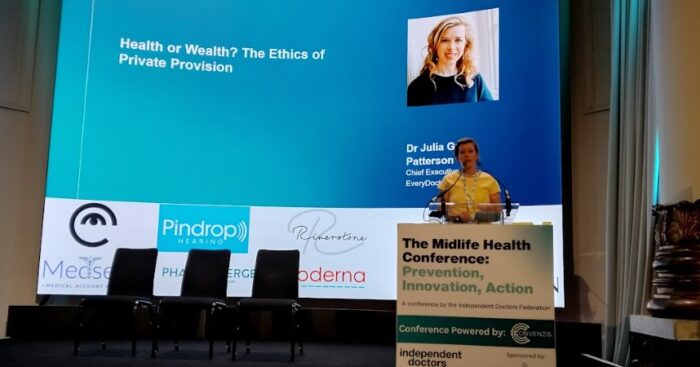
The UK’s healthcare system operates in an unequal playing field “heavily tilted” towards the private sector with three myths about its support of the NHS being perpetuated by politicians.
This is according to Dr Julia Patterson, chief executive at EveryDoctor (pictured), who addressed the Independent Doctors Federation Conference in London.
Patterson, whose non-profit organisation launched in 2019 with the belief that doctors have the power to end the NHS crisis, outlined three myths she maintained were being perpetuated by politicians about what the private sector represents and how it is helping the NHS.
These myths include that the private sector’s spare capacity is driving down NHS waiting lists, that the sector wants to help the NHS and that it is doing enough to train new talent.
“They are in my opinion highly unhelpful both for the NHS and also for the private healthcare sector,” Patterson said.
“I don’t often see the private healthcare sector perpetuating these myths, but they are certainly out there in the public conversation.”
Spare capacity
The first myth from the Labour government, Patterson maintained, is that the private sector’s spare capacity is being used to bring down NHS waiting lists.
“There was a big deal that was entered into and announced on the 6 January this year which showed probably an extra £2.5bn in England is being directed to private companies to deliver elective care,” Patterson told delegates.
“Now that is money that could have been used to invest in the NHS to deliver more elective care in the NHS.”
But Patterson argued this was a politically motivated decision.
“There has been a political decision to direct that money into private companies instead,” she continued.
“The government is not being upfront about that.
“And the reality of this is that it’s not spare capacity within the private sector anymore, the government is choosing to build capacity in the private sector by directing money into the hands of the private sector. That’s the reality.”
Cost cap
The second myth, Patterson outlined, was the idea that private companies want to help the NHS.
Patterson explained that the government’s deal with the private sector announced on 6 January involves a “cost cap”.
“Essentially the private company gets paid per patient they treated and there was going to be a cap on that,” she said.
Patterson told delegates: “It’s just like any NHS service has a cap on the number of patients they can treat because of budgets, right? That’s partly why we have such long waiting lists.
“The private companies have successfully negotiated away that cost cap, so there is no cost cap.
“So the private companies can treat as many patients as they want, bringing down their own waiting lists.
“Meanwhile the NHS waiting lists are very long. People wait a very long time, don’t they?”
Choosing to give private sector an advantage
Patterson accused politicians of “choosing” at the moment to give the private sector an advantage over NHS services and at the same time tell the public that private companies are helping the NHS.
“I think that’s wrong and don’t think that’s honest,” she continued.
“There is a very, very unequal landscape between the NHS and the private companies who are delivering NHS care.
“We need to face up to that reality.
“I don’t think it’s very democratic if we’re thinking about democracy at its widest definition of the term if we have a public healthcare system which is tasked with giving equal and comprehensive care for all and is funded primarily through taxation where there is an unequal landscape heavily tilted in favour of private healthcare companies taking on NHS work.”
Choosing attractive areas
Patterson explained that currently private companies can choose attractive areas of the NHS to get involved in, for example elective care.
“We’ve seen ophthalmology, orthopaedics, all the ones you’re familiar with,” she said.
“Some of those companies are making astronomical profits from the work they do in the NHS.”
She also highlighted recent reports examining how this work was affecting the markets and provider incomes.
“They’ve shown that the five main eye companies doing cataract and other eye treatment made £169m in profit in 2023/24,” she continued.
“That’s the same amount of profit as 100 private finance initiative deals.
“That’s not right, is it? There should be a profit cap in some way on the amount of profit that can be generated from NHS care.”
Training new talent
But this inequality has only been widened with the NHS burdened with the “vast majority” of healthcare training in the country, Patterson maintained.
“Private healthcare companies recruit people who would otherwise be working in the NHS to work within their companies,” she continued.
“There should be an obligation for private companies to train their own staff and that obligation simply doesn’t exist at the moment.
“Just as one example of this, a report came out in January 2024 from the Independent Healthcare Providers Network where they asked their own members how many staff they have been training.
“That showed 109 doctor training placements were taking place in the year 2022/3 – 109, that compares with the NHS who were delivering training for 75,000 doctors at the moment. That’s not fair, is it?”
Up to doctors to change things
And Patterson maintained that politicians have not been calling any of these myths into question.
“And when I look at the 10-year plan and scrutinise the detail of it, when I’m listening to Lord Darzi, I don’t hear this critique,” Patterson continued.
“I don’t hear a demand for an equal landscape. I don’t hear that we want democracy within healthcare and within the public healthcare system and that’s wrong.”
Patterson added that she thought most doctors want to feel they are working for an employer that is ethical, works fairly and adds value to the wider landscape.
“I think that’s important to most doctors, so I won’t criticise any doctor for wherever they want to work, but I do think that doctors can achieve change here,” she continued.
“I don’t think the chief executives are going to do it. I don’t think that the shareholders are going to do it. But I do think that people working within those private healthcare companies have an opportunity to change things.”