
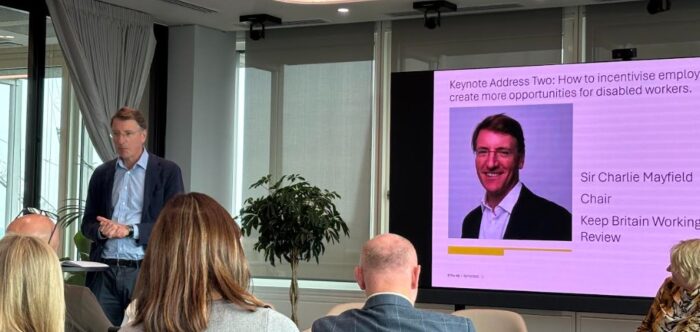
Sir Charlie Mayfield has challenged insurance providers to develop risk pooling for SMEs to enable their employees to gain access to affordable health and wellbeing benefits.
Risk pooling already exists in the pensions space with the likes of the National Employment Savings Trust (NEST), but Sir Charlie suggested such methods could be ‘very important’ if adopted within workplace health to improve outcomes and access.
Sir Charlie (pictured), who is leading the Keep Britain Working Review, also urged the insurance industry to focus on preventative care and innovation to keep people healthy.
Speaking at the Association of British Insurers (ABI) Keep Britain Working conference, the former chairman of John Lewis added he is hopeful his government-commissioned Keep Britain Working review could be published ahead of the Budget in November.
Sir Charlie highlighted three steers for the insurance industry as part of the review: stopping people from falling out of work due to ill health in the first place, improving available health and wellbeing data, and making workplace health more accessible and affordable.
“We’re very interested in things that you may be able to do and take a lead on in terms of risk pooling, whether you can aggregate demand regionally, or by sector so that we can give access to economies of scale to smaller businesses that are enjoyed by larger businesses,” Mayfield told delegates.
“That feels very important.”
Prevention, innovation and data
On prevention, Mayfield gave the example of mental health, calling on insurers to think about ways they can prevent people from developing severe mental health issues as early as possible in the life cycle.
But Mayfield added there was also “tremendous” scope for insurers to innovate, adding that young people may be happier talking to a chatbot than a human being, while line managers may like routes to really timely advice where they are nervous about talking to an individual employee.
Turning to data, Mayfield encouraged providers to think about its importance as he said it is vital to create different mechanisms where data can be aggregated to build evidence cases to both identify what really works in different situations to start driving adoption of health benefits.
Ultimately, Mayfield said his review will call for a shift in the way people engage with healthcare in the country.
“We are going to be advocating for a big shift from health being predominantly the preserve of the individual and the NHS to one where health becomes much more of a partnership between employees, employers and providers, health services,” he said.
“We think that’s an important shift. It’s obviously not a straightforward one, but one that could make a real material difference to individuals, to employers and to the government ultimately.”
Last November, Sir Charlie was charged by the government with leading the Keep Britain Working Review, an independent review focusing on what more employers can do to tackle economic inactivity due to ill-health and disability.
He has already spoken about how group income protection and private medical insurance can support keeping people healthy and in work.