• Content Hubs
    • AI in Insurance
    • Bupa
    • UnitedHealthcare Global
  • Supplements
  • About
  • Alerts
  • Advertise
  • Events
  • Research
  • Contact
SUBSCRIBE
No Result
View All Result
Health & Protection
  • PMI & Healthcare
    • Individual
    • SME
    • Large Corporate
    • Cash Plans
    • Hospitals
  • Protection
    • Group Risk
    • Individual Protection
  • International
  • Wellbeing & Mental Health
    • Absence/Productivity
    • Mental Health
    • Services
  • Appointments / Industry
    • Appointments
    • Company News
    • Compliance & Regulation
    • Economy
Health & Protection
No Result
View All Result

Protection sales down almost 50,000 in 2023 – Gen Re

by Graham Simons
18 December 2023
Quilter profits slump and advisers depart despite protection income boost
Share on FacebookShare on Twitter

Almost 50,000 fewer protection policies have been sold in the first three quarters of 2023 compared to the same period last year, according to Gen Re.

The figures are likely to be disappointing for the market after a strong start to the year which has been followed by two consequtive quarters of retraction.

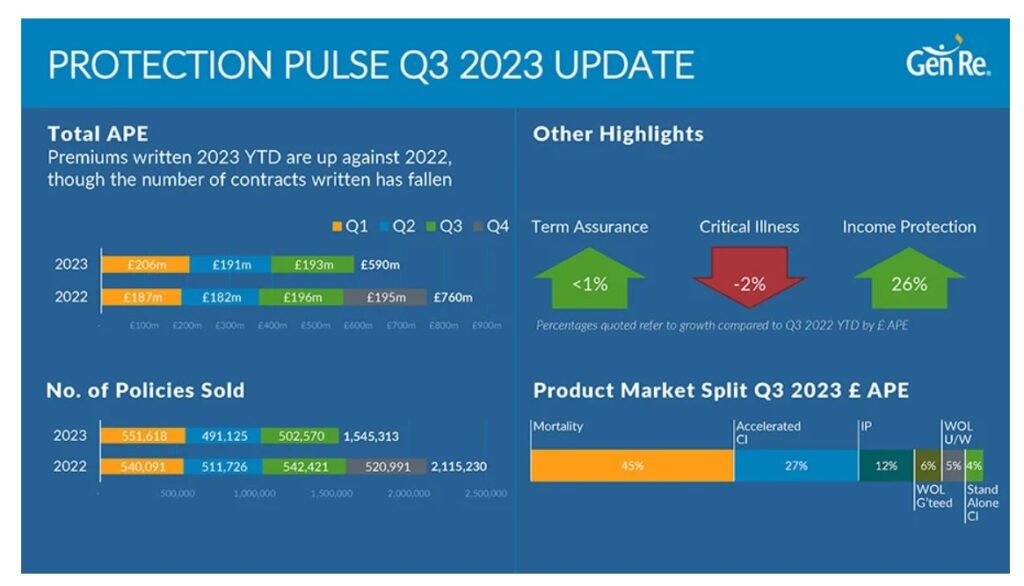
The reinsurer’s Protection Pulse update showed 1,545,313 policies have been sold so far this year, down by 48,925 from 1,594,238 in the first three quarters of 2022.

While Q3 saw more completions than Q2 2023, the figure was 49,048 down on the first quarter of the year and 39,851 down on the corresponding quarter of last year when 542,421 polices were sold.

There was a bright spot with total annual premium equivalent (APE) at £590m over the first nine months of the year, up 4.4% from £565m at the same point last year.

APE also rose to £193m for July to September, from £191m in the previous three months, but this was down from £206m in the first quarter of the year and also down from £196m in the same period of 2022.

Across product group in terms of APE compared to a year ago, income protection saw a 26% increase, while term assurance saw a negligible increase and critical illness was 2% down.

Turning to product market split, mortality accounted for 45%, with accelerated CI comprising 27% of the market, income protection 12%, whole of life guaranteed 6%, whole of life U/W 5% and standalone critical illness 4%.
 

Next Post
Updated: Taurog appointed MD of VitalityLife as Skinner steps up to group CFO

Young adults most likely to cancel and reinstate life insurance - Vitality

Protection drives Royal London growth with demand for IP and business cover

Tavistock turns £240k profit as protection acquisition boosts bottom line

Legal & General offers special pricing and benefits for Co-op life and CI tie-in

HAVE YOU READ?

Private cancer care levels held firm throughout first lockdown, figures show

Individual PMI growth easing as focus on affordability and younger families – analysis

19 March 2026

Read more
IP advisers need to ‘reframe’ message to engage younger consumers

IP advisers need to ‘reframe’ message to engage younger consumers

17 March 2026

Read more

AI IN INSURANCE LEADERSHIP

Health & Protection

© 2025 Definite Article Limited. Design by 71 Media Limited.

  • About
  • Advertise
  • Privacy policy
  • Terms & Conditions
  • Contact

Follow Healthcare & Protection

X
No Result
View All Result
  • PMI & Healthcare
    • Individual
    • SME
    • Large Corporate
    • Cash Plans
    • Hospitals
  • Protection
    • Group Risk
    • Individual Protection
  • International
  • Wellbeing & Mental Health
    • Absence/Productivity
    • Mental Health
    • Services
  • Appointments / Industry
    • Appointments
    • Company News
    • Compliance & Regulation
    • Economy

No Result
View All Result
  • PMI & Healthcare
    • Individual
    • SME
    • Large Corporate
    • Cash Plans
    • Hospitals
  • Protection
    • Group Risk
    • Individual Protection
  • International
  • Wellbeing & Mental Health
    • Absence/Productivity
    • Mental Health
    • Services
  • Appointments / Industry
    • Appointments
    • Company News
    • Compliance & Regulation
    • Economy