
Vitality is launching an artificial intelligence (AI) powered service with Google which it will use to apply greater health insights and actions to customers across its insurance products.
The insurer aims to translate its wide range of data shared by customers into actionable insights and provide a regular single point of optimisation for members through its app.
These insights and actions can be updated in near-real time once fresh data has been received from the member.
The insurer is also extending its range of behaviour measurements and actions to sleep monitoring by including data from Oura rings.
Unveiling the product, founder and group chief executive of the Discovery Group Adrian Gore said: “The stack is complicated but we make it simple for customers.
“We want to find the action that has the most value for that individual.”
The technology is still being actively used among staff as it is being tested with a full launch date for the UK and other markets yet to be set.
The process involves Google’s Gemini AI system analysing the member’s health and lifestyle factors such as existing conditions and activity and then comparing it with its wider anonymised data set to provide comparisons and other deeper insights.
Through this, customers will receive personalised, actionable insights, which are tailored to each individual’s unique health, lifestyle, and key risk factors, to help reduce illness and extend healthy years, the insurer said.
These recommendations include lifestyle choices like physical activity or getting better sleep, along with health actions such as attending screenings and taking part in wellness coaching.
Interpret data and respond
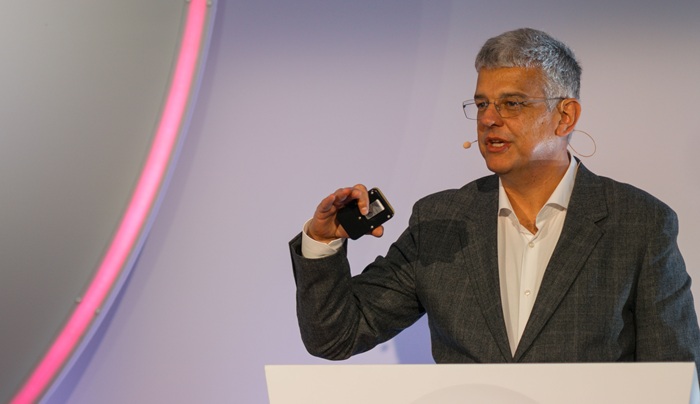
Vitality AI managing director and global chief actuary Emile Stipp (pictured) explained the approach and how the system would work to encourage and motivate people to participate in healthy behaviours.
“Our propensity models have to update all the time on the actions that people take and also the actions that they don’t,” he said.
“That’s complex because behaviour is complex, so there’s a lot of complexity behind these models, but it needs to respond.
“To do that, you need AI with the power of predictive AI and of generative AI to interpret the data all the time, to react to what is relevant at that moment in time, and then to respond in the right way, in the way that we recommend to people.”
Stipp added that the insurer was bringing together all of the health data available and make it very specific to the individual and understand is what is the most valuable feature to that individual.
“Our work with Google is really to consolidate everything onto a single global platform in all of the markets where we operate,” he continued.
“We make sure that the data lineage is documented, the data quality is absolutely guaranteed, the taxonomy, the governance, the privacy, security, the standards of truth.
“We need to know whether what we’re seeing is a good reflection of what you actually do in practice. All of that is built into this platform we’re building together with Google so that we can deliver these insights.
“It’s a unique combination of data, and that is the foundation on which we build everything.”
From there dynamic risk assessments and causal models are used to assess the likely outcomes if the member’s behaviour remains or if they change, and that is then quantified into insurance value.
‘Pretty instant’ updates
Stipp later told Health & Protection the system can respond to changes and send updated notifications in a matter of minutes once it has received the data.
“We don’t necessarily know that you hurt your knee yesterday until you start seeing treatment, until we get the claim,” he said.
“When the claim is submitted in most cases it’s pretty instant that the data comes in and a big part of our engineering, is just to make sure that it flows through to all of these complex data systems and it’s available to the models.
“But there’s a safeguard too; as far as possible whenever the model is telling you something, you can always click through to see why is it telling you this?
“When you do, it will say based on this and this and that data and that way you know if you see something that’s relevant but not there, you know the data is not there and hence you interact with it in a different way.
“So we try and build that explainability into it all the time.”