How artificial intelligence (AI) creates a return on investment is still the big question that insurers need answering, Health & Protection’s IPMI breakfast briefing in association with Flywire has heard.
This was a key point raised by Algirdas Dineika, managing director and head of technology consulting for the UK and Ireland at WTW.
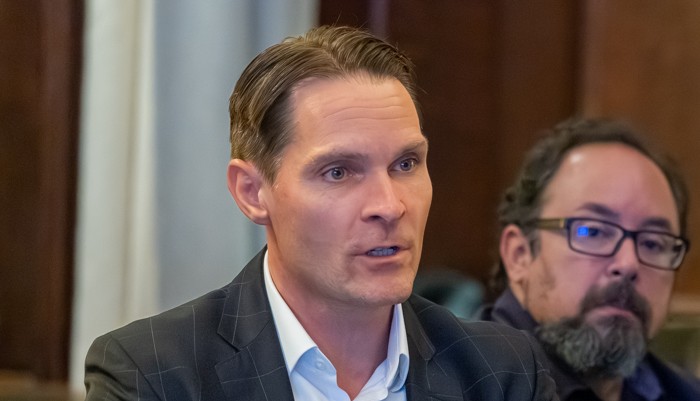
Speaking about the role AI could play within the insurance industry, Dineika (pictured) pointed to an interesting shift in how organisations see AI.
Last year, he said, people were testing it and trying to see where it brings value. Now they are trying to understand how to deploy AI at scale.
However, Dineika added that there is a lack of the technological skill needed to achieve this, which can only drive costs higher than anticipated.
“We’re coming back to the fundamental question of what’s the return on investment,” he said. “That question needs to be answered.”
Dineika continued to explain that during the next two years he expects leaders to embed AI agentic skills within their organisation and start to operate in a way where they believe return on investment can be earned.
And the reason for his positive outlook?
Last year Dineika spoke with business leaders who were experimenting with AI but were sceptical. They said things like: “AI technology is interesting, but we don’t think it can be deployed in a real-use case within our organisation in the next year.”
A year later he is hearing: “We’re not thinking if the real AI use-case can be deployed as we did successful experimentation already, we’re thinking about how to scale it.”
Mandated
One trend driving this is a leadership culture and AI mandate. “There is a massive trend nowadays where CEOs are saying in investor presentations that AI will help improve efficiency by a certain percentage, and then work backwards to figure out how to achieve it,” Dineika said.
“But in reality those gains come from a spectrum of solutions: generative AI, agentic AI, predictive analytics and process optimisations.
“There is a huge mandate in the culture that drives the adoption of AI,” he added.
“The key question in that case is, are we defining and designing architecture for the world we know or are we trying to image the future?”
Whatever the answer to that question is, when it comes to deploying AI within an organisation, people will be at the heart of it. “There is still no universal pattern of what an AI native company or function looks like.
“Most so-called native AI firms are three or four-years-old and they still don’t serve as a pattern of what an AI native organisation is.
“The key question in that case is, are we defining and designing architecture for the world we know or are we trying to imagine the future?
“And imagination is needed to figure out how to employ AI within your organisation.”
Paradigm shifts
AI is where digital was in 2010 where companies were trying to work out how to implement it and, perhaps, if they should reimagine their business model over how AI will enable them to interact with customers and suppliers, Dineika continued.
“That is the inflection point,” Dineika said. “We have seen a couple of paradigm shifts in technology and AI brings another one, but we are still in the process of defining what it will become.
“We are going to need to figure that out.”