Loaded premiums are fine, so long as the protection sector clearly explains to young customers what they are for and what they are paying for.
This is according to a panel at Protect Z 2026 who were asked about loaded premiums, with the Financial Conduct Authority stopping short of banning the controversial practice in their Protection Market Study interim report at the start of this year.
Transparency and clear communication
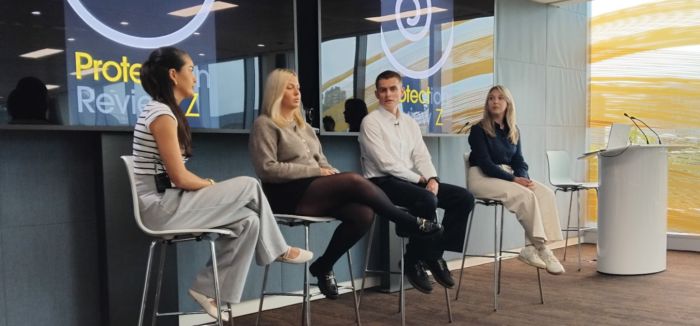
“I think for Gen Zs [people born between 1997 and 2012] generally it’s all about transparency and clear communication,” Laura Mitchell, marketing manager at Guardian (pictured furthest right), told delegates.
“If information tries to conceal or tries to hide or not being upfront about, as a generation we’ve got access to more information than any generation ever has at this age, you will get found out. It will be discovered.
“Would you not rather that information come upfront, from us, with a really clear understanding of what commission is, how it works and why we do it then find that out from ChatGPT or TikTok or something like that?”
Being clear from the start
Mitchell maintained that it was important the sector takes control of this issue and is clear and upfront at the start.
“I think there’s space for all kinds of distribution models. I think we just need to be clear about how we communicate that,” she added.
“A lot of people don’t mind paying for a service if they know why they are paying for it, so being really clear about what you get for that and how it could be better, what service levels you get for it, I think is also key.”
Beth Southcott, senior marketing executive at UnderwriteMe (pictured furthest left), agreed, adding: “I think it’s about understanding and just transparency is the key.”
A turn off
For Eoin Collins, business development actuary at Hannover Re (pictured second from right), the ‘loaded’ in loaded premiums can be a turn off to Gen Z.
“When you talk to Gen Z, or somebody in the street, I don’t think that is transparent and doesn’t send the right message to the consumer,” Collins contended.
“I think if you package it in a different way. I know in different markets and products, there is differentiation in pricing. So maybe it’s not necessarily the worst outcome, but there needs to be transparency about what this practice is and why it’s done.”
Sounds worse than it is
But Britney Trussler, senior protection adviser at Dynamo (pictured second from left), said she thought the term suffered from sounding worse than it is.
“From the market study, there was only a small discrepancy between loaded and non loaded,” Trussler said.
“We’re not talking about two, three times the premium which is the notion I think people have in their heads.
“I think it’s less about the loaded panels and just about making sure there is transparency, the quality is there and the service they are paying for is factored into it.”