Private medical insurance (PMI) funded hospital admissions fell year-on-year in the first quarter of 2026, marking the first decline in Q1 insured admissions in the past five years.
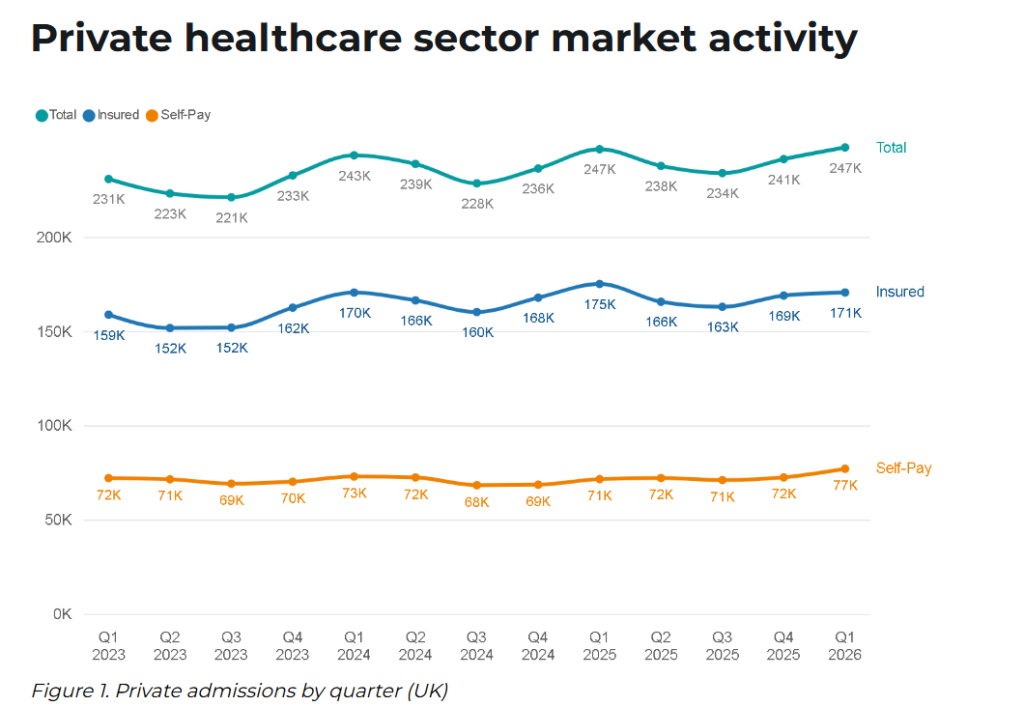
Private Healthcare Information Network (PHIN) data showed there were 171,000 insurance-funded hospital admissions in Q1 2026. While this was up 2,000 on the final quarter of last year, this was down 4,000 on the corresponding quarter of 2025.
Stable picture
lucy rigby
And self-pay admissions, which have remained at a fairly consistent level for the past few years, were up 7.7% to reach their highest ever level.
In Q1 2026, total admissions were up in England (0.9%), and down in Scotland (1.3%), Wales (4.7%) and in Northern Ireland (8%).
Insured admissions
Reported admissions paid for with private medical insurance in Q1 2025 fell 2.6% compared to the same period in 2025. There were 4,530 fewer insured admissions than in Q1 2025 across the UK.
While the number of admissions using private medical insurance fell across England (2.2%), Scotland (7.1%) and Northern Ireland (16.4%), there was an increase in Wales (6.3%).
Insured admissions rose across five English regions (East of England, North East, North West, West Midlands and Yorkshire and The Humber) and declined in the remaining four (East Midlands, London, South East, South West).
Self-pay
UK self-pay admissions were up 7.7% in Q1 2026 compared to Q1 2025. They increased in every nation, up 9.5% in England, 6.6% in Scotland, 4.2% in Northern Ireland, with the exception of Wales, down 13.3%.
Rise in cataract admissions
The data pointed to a reduction in admissions for five of the Top 10 procedures by volume when comparing Q1 2025 to Q1 2026.
Admissions for cataract surgery increased the most (12.8%) with 22,805 admissions. There were also increases for therapeutics – chemotherapy (1.1%), hip replacement (primary)’ (4.2%), knee arthroscopy (0.4%) and inguinal hernia repair (1.1%).
Upper GI endoscopy with 11,895 admissions (-4.5%) and colonoscopy therapeutic with 4,310 (-9.5%) saw the two largest declines.
Weight-loss surgery decline
Looking beyond the Top 10 procedures for both payment methods, there was a 43% increase in eyelid lift – blepharoplasty, and a 45% increase in breast lift – mastopexy.
Weight-loss surgeries continued their decline in popularity with gastrectomy’ (-49%) and gastric balloon (-79%) down. Eyelid reconstruction (-82%) and allergy testing (-87%) also witnessed sharp declines in admissions.
More active consultants
In the first quarter of the year, there were more active consultants (11,600) than in any other quarter during the past five years.
Though PHIN noted the number of consultants active in private healthcare regularly fluctuates as new consultants start working in the private sector, and existing ones go on sabbatical, stop working privately, or retire.
There was an increase in the number of active consultants in each of the named specialties in the top 10 except for ophthalmology’, ear, nose and throat (ENT) and medical oncology.
The largest increases by number of consultants were in trauma and orthopaedics (71) and gastroenterology (55).
The biggest percentage increases came in gastroenterology (7.5%) and gynaecology (5.8%).
Increase in demand from people in their 50s
Insured admissions decreased for both sexes across the UK, and there was an increase in self-pay admissions.
The most admissions (49,705) came for patients in the 50-59 age group, however this was a lower total (-1,285) than in Q1 2025.
The largest volume increase was for the 60-69 age group (1,545) and 70-79 (1,270).
The biggest declines in admissions by percentage were seen in the youngest and oldest age groups, with those aged up to nine down 22%, and those 100-109 down 33%. The 0-9 age group also had the largest volume decrease (990).
NHS admissions
The proportion of admissions in the NHS were marginally up (1%) compared to Q1 2025. Admissions at private hospitals funded privately (insurance or self-pay) remained the same. There was a small decline in admissions to private hospitals that are funded by the NHS.
The majority of admissions (88%) were via NHS hospitals and NHS funded.