
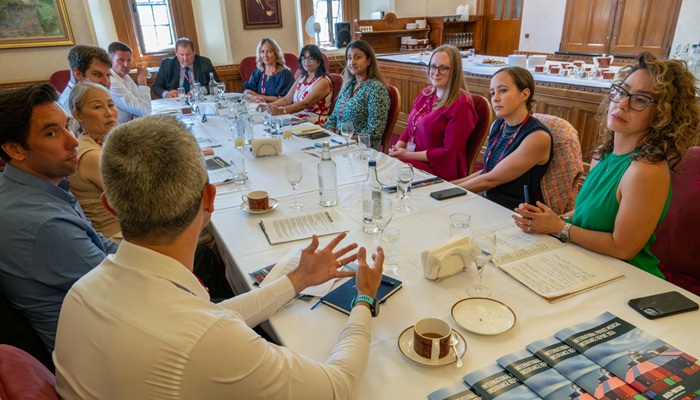
Expectations around service levels are high, but IPMI needs a human touch despite AI advances, writes Mark Dunne.
Customers are demanding “gold-plated service” to go with their international private medical insurance (IPMI) meaning providers and advisers are continually under the microscope, Health & Protection’s House of Lords roundtable heard.
This is despite Health & Protection Service Rating scores continuing to rise as insurers invest in new people and technology including artificial intelligence (AI).
Indeed, AI is such an important issue that some clients are asking insurers to prove how they are using the technology and demanding human input.
They want people to make clinical decisions, noted Claudine Audin, director of client management and broker support at UnitedHealthcare Global’s.
“It is fine to use for some of the basics around organising and processing, but they have been clear about any clinical interventions,” she said.
“There’s still some nervousness around the impacts of AI.”
Amanda Olore, head of strategic relationships at IMG, highlighted the underlying cause of concern: “AI is such a powerful tool we have to use it properly.”
Given its potential power, the panel acknowledged the industry must show clients how it is being used positively to help them.
Matt Howells, founding partner of Vizion Health, emphasised the right balance needs to be achieved between implementing AI and allowing for human interaction.
“Having AI in the background would definitely work in the individual market, but having someone who picks up the phone is even more important,” he added.
Download the full roundtable supplement here
Great expectations
This is also a time when customer demands are soaring.
Members’ expectations have changed because they are paying more for their medical insurance than ever before, Marsh UK leader of global mobility solutions Dave Hilton explained.
“Their expectations are not just gold-plated benefits, but a gold-plated service,” he said. “That’s where we probably see a little bit more friction, because sometimes it’s not quite as concierge quality as they expect it to be.”
Yet it is difficult to provide a seamless service at scale when offering international policies.
UnitedHealthcare Global’s Audin pointed out the insurer’s domestic health insurance members can typically pre-authorise on an app.
“On an international scale it’s difficult because in each region you have a different third-party administrator (TPA) or you have different partners you work with,” she said.
“To try and integrate all of that is difficult, but that is the way to improve some of that experience,” Audin said.
Advisers also acknowledged the challenges providers face in meeting growing demands and wanted to be part of the solution when working with them.
Small window
Howden senior international consultant Sharon Sunners explained renewal is another critical period and common pinch-point for service where there is room for improvement and for collaboration.
She noted clients are “more sophisticated, more aware and want more information from us”.
Working with large community-rated schemes, a significant challenge is the terms typically arriving only six to eight weeks before the expiry date.
“It’s really challenging trying to get data in a meaningful way, consult with the client and explain it, and then actually do anything about it in such a small window,” Sunners said.
The timing of the renewal window is also a challenge PIB Employee Benefits principal consultant Takako Nagata has faced.
“Six weeks to put everything to market, write the report and peer review – it is a short time to give proper advice and look at the market,” she said.
“To find the best solution is difficult and time-consuming work.”
However, working closely with insurers is one route to managing potential price increases and easing time burdens.
“We try and get ahead of that as soon as possible,” Sunners said.
“This is why it pays to have good relationships with insurers because you get a bit of an insight before the terms are due.”